Black tourmaline is the stone people buy when they want something that feels solid, dark and dependable. In crystal shops it is usually sold as a rough stick with deep grooves, or as glossy black tumbles in a bowl by the till. It is affordable, easy to recognize once you know what to look for, and it carries one of the strongest reputations in modern crystal lore.
Before the meanings, the geology, because it explains a lot about how to buy and care for it.
Black tourmaline is schorl
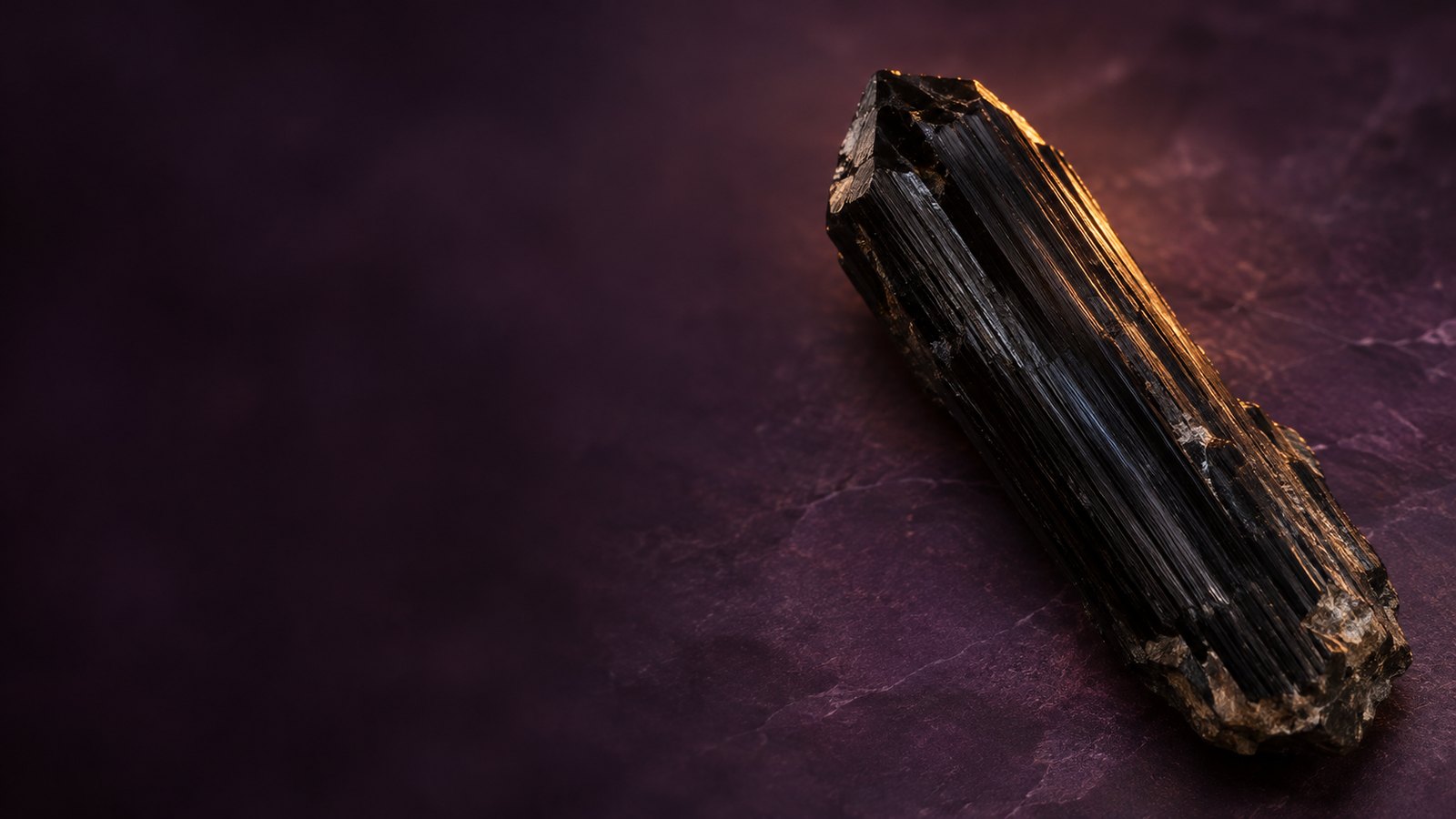
Tourmaline is not one mineral but a family of closely related boron silicate minerals in many colors. The black one is almost always schorl, the iron-rich member of the group. According to the Handbook of Mineralogy, schorl has a hardness of 7, grows as prismatic crystals up to 1.5 meters long that are commonly striated along their length, and is black, brownish black or bluish black. The same reference notes that it is both pyroelectric and piezoelectric, which means it builds up an electric charge when it is heated or squeezed.
Schorl is also by far the most common tourmaline. According to the Wikipedia entry on tourmaline, it may account for 95% or more of all tourmaline in nature. That is why a good black tourmaline stick costs so much less than a pink or green gem tourmaline of the same size.
The name is old. The same Wikipedia entry traces "schorl" to before 1400, when a village in Saxony, Germany, known today as Zschorlau, was called Schorl and had a nearby tin mine where black tourmaline was found. The first written description of the mineral under the name "schürl" was published by Johannes Mathesius in 1562.

Black tourmaline meaning in crystal tradition
In modern crystal practice, black tourmaline is the protection stone above all others. The meanings people give it cluster around a few ideas:
- A shield. Many practitioners describe it as a stone that guards a person or a space, and place it by the front door, at the corners of a room or on a desk as a symbolic boundary.
- Grounding. It is linked with the root chakra at the base of the spine and with feeling steady, present and "earthed."
- A filter. Some people believe it turns heavy or unwanted energy into something lighter, and keep it near busy spaces in the home.
- Letting go. Others hold a piece at the end of the day as a ritual for putting down what they no longer want to carry.
There is a lovely historical echo behind its "magnetic" reputation. According to the Wikipedia entry on tourmaline, Dutch traders brought tourmaline to Europe from Ceylon (Sri Lanka), and it was sometimes called the "Ceylonese Magnet" because, when warmed, it could attract and then repel hot ashes. GIA confirms the physics behind the story: tourmaline becomes electrically charged when heated, and also when squeezed. The charm of the old name lives on in crystal lore, even though the effect is a simple property of the mineral.
You will also see listings that promise black tourmaline blocks phone signals or Wi-Fi. That is a sales claim, not part of the old lore, and we leave it out. Enjoy the stone for its beauty and its meaning to you.
Where black tourmaline forms
According to the Handbook of Mineralogy, schorl forms in granites and granite pegmatites, in high-temperature hydrothermal veins and in some metamorphic rocks, often alongside quartz, feldspars, muscovite mica, garnet and beryl. Pegmatites are coarse-grained granite bodies where crystals have room to grow large, which is why you can find long, well-formed sticks.
The Wikipedia entry on tourmaline lists Brazil and many parts of Africa, including Namibia, Madagascar and Mozambique, as the chief sources of gem and specimen tourmaline, with production also in Pakistan, Afghanistan and Sri Lanka. In the United States, tourmaline was first discovered in Maine in 1821.
Black tourmaline also turns up inside clear quartz as fine black needles. That combination is sold as tourmalinated quartz, and it is a favorite with people who like the meanings of both stones in one piece.
How to identify real black tourmaline
Real schorl is one of the easier stones to check by eye. Three features do most of the work:
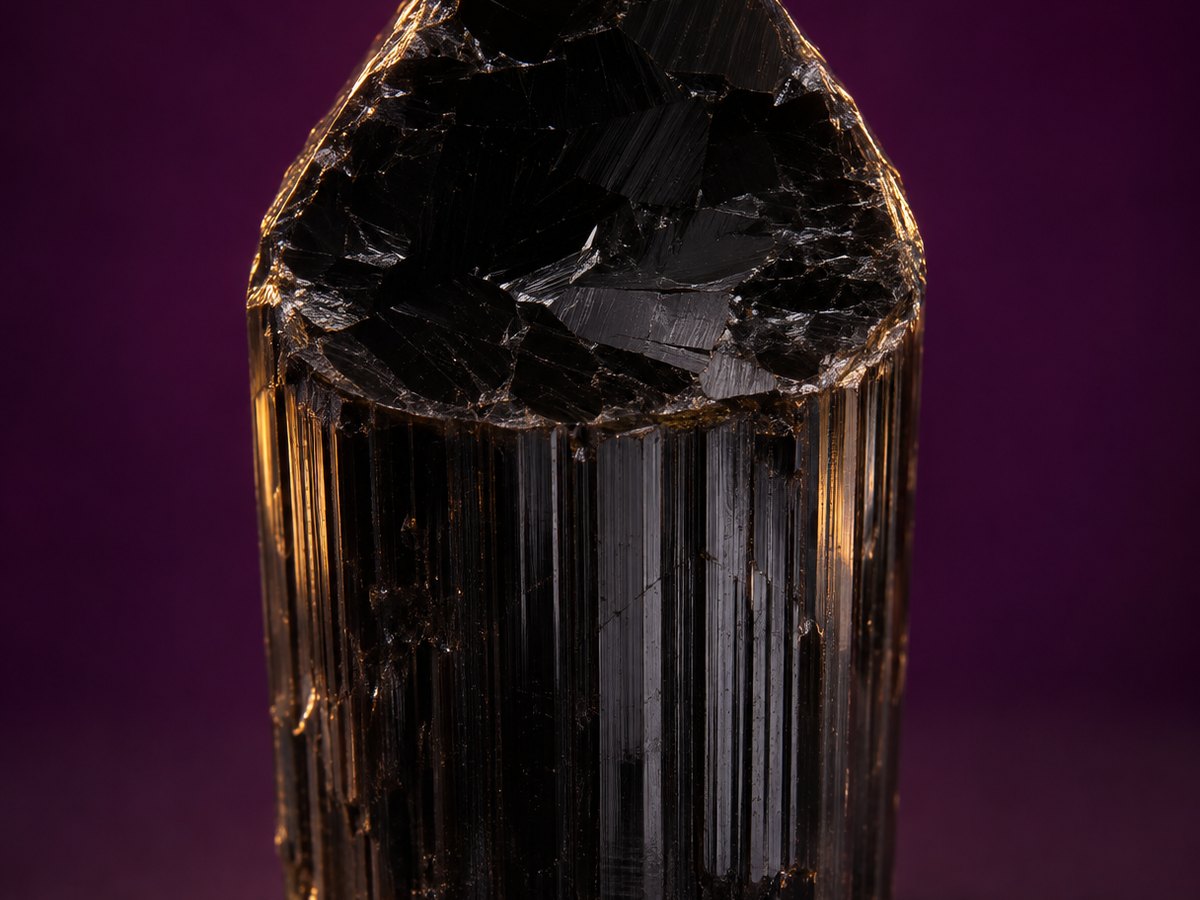
- Lengthwise grooves. According to the Handbook of Mineralogy, schorl crystals are commonly striated parallel to their length. Raw sticks should show fine parallel grooves running end to end.
- A rounded triangle at the end. Look at the broken end of a crystal. Anima Mundi Crystals' identification guide points out that schorl's cross-section is a triangle with rounded, bulging sides, which helps tell it from hornblende, a common black look-alike that splits along two cleavage directions.
- Hardness and shine. At hardness 7, schorl will scratch glass. A fresh surface has a glassy to slightly resinous shine.
Polished tumbles are harder to judge because the grooves are gone. With those, buy from a seller who names the mineral, and be wary of perfectly uniform, featherweight black beads, which may be glass or resin. Black obsidian and black onyx are both lovely, but they are different stones with their own lore and should be sold under their own names.
How people use black tourmaline
- By the door. The most common tradition: one raw stick just inside the front door.
- In the four corners. Small pieces at the corners of a room or home, often placed with a spoken intention.
- On the desk. Many people keep a piece beside a computer or workspace as a grounding reminder during the day.
- In a pocket or as jewelry. Tumbles and pendants make it easy to carry. Raw sticks are brittle, so they suit shelves better than pockets.
- Alongside other pieces. Some people build a whole "grounding corner" with dark stones, orgonite and sacred geometry. Our iPyramids harmonizers section shows the gold-plated geometry and orgonite pieces in that collection.
In crystal practice, protection stones are often "cleansed" more frequently than others. Popular methods include incense smoke, sound from a singing bowl, or a night by a window in moonlight.
How to care for black tourmaline
Tourmaline is tough on the scratch scale but needs a little thought elsewhere. According to GIA, its toughness is rated fair, it is generally stable to light and chemicals, and heat is the thing to avoid: high heat can change its color and sudden temperature changes can cause fracturing.
- Clean it simply. GIA recommends warm, soapy water for cleaning tourmaline and does not recommend ultrasonic or steam cleaners. A soft brush helps reach into the grooves of raw sticks.
- Dry it well. Pat it dry, then let raw pieces air-dry so water does not sit in the cracks.
- No candles or hot sills. Keep it away from open flames, radiators and the full heat of a sunny window, and never plunge a warm stone into cold water.
- Handle raw sticks gently. The Handbook of Mineralogy describes schorl as brittle, so long crystals can snap or shed splinters if dropped. Store them on a soft cloth, not loose in a bag.
- Keep small pieces from little hands. Tumbles and chips are a choking hazard for small children and pets.
Choosing a piece
For a first black tourmaline, a raw stick with clear grooves and a solid feel in the hand is hard to beat. It shows you exactly what schorl is, it is easy to verify, and it carries the tradition in its most recognizable form. Find a spot for it that matters to you, set your intention, and let it be your reminder.
Quick answers
What is black tourmaline called as a mineral?
Black tourmaline is schorl, the iron-rich member of the tourmaline group. It is by far the most common tourmaline in nature, which is why it is so affordable.
What does black tourmaline mean?
In crystal tradition, black tourmaline is the classic protection stone. People link it with grounding, the root chakra and setting boundaries, and often keep a piece by the front door or on a desk. These are beliefs rather than proven effects.
How do I know if my black tourmaline is real?
Raw schorl shows fine grooves running along the length of the crystal and a rounded triangular shape at the broken end. It is hard enough to scratch glass. Polished tumbles are harder to judge, so buy from a seller who names the mineral.
Can black tourmaline get wet?
Yes. GIA recommends warm, soapy water for cleaning tourmaline and advises against ultrasonic and steam cleaners. Dry it well and avoid sudden temperature changes, which can cause cracks.