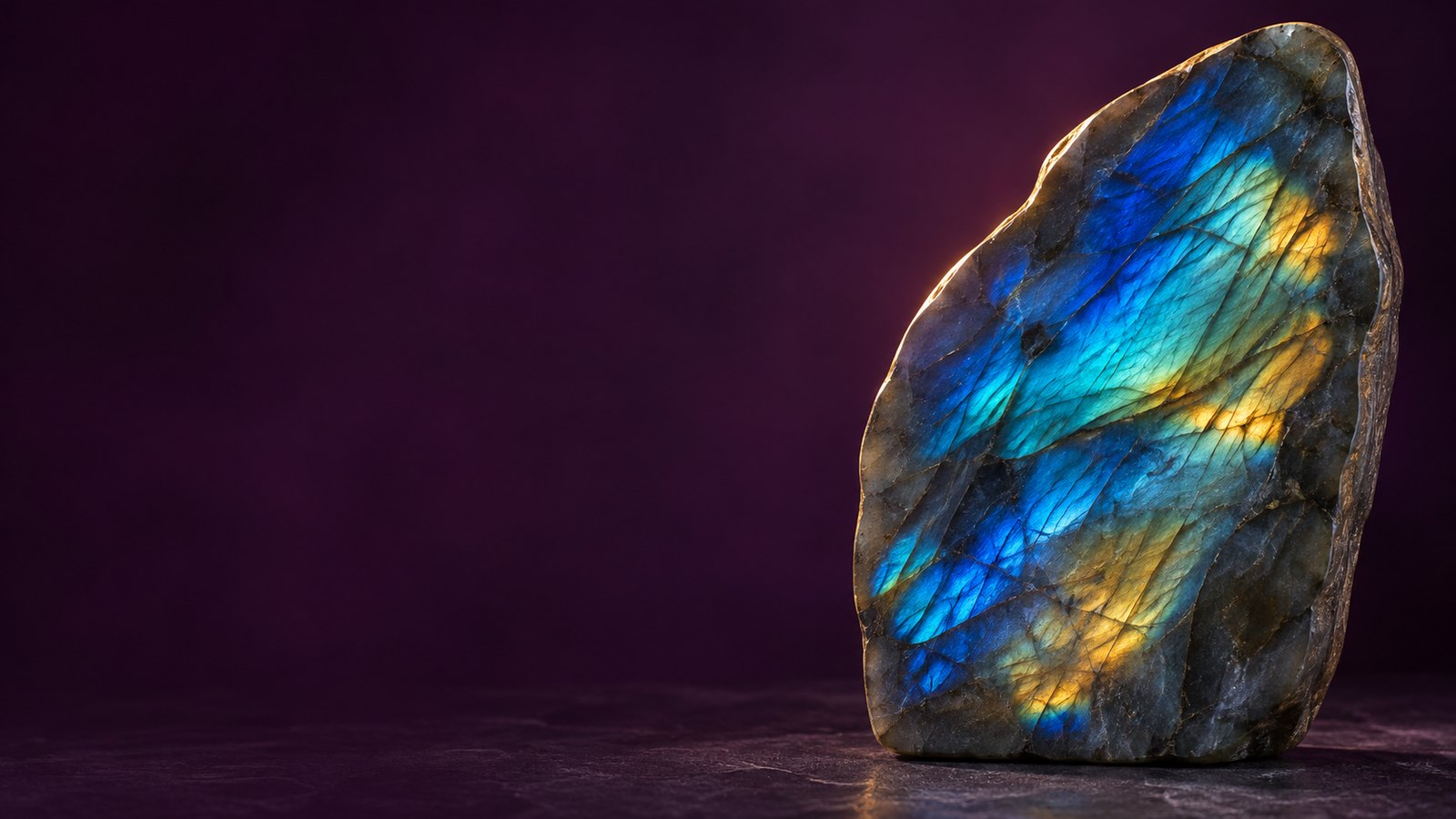
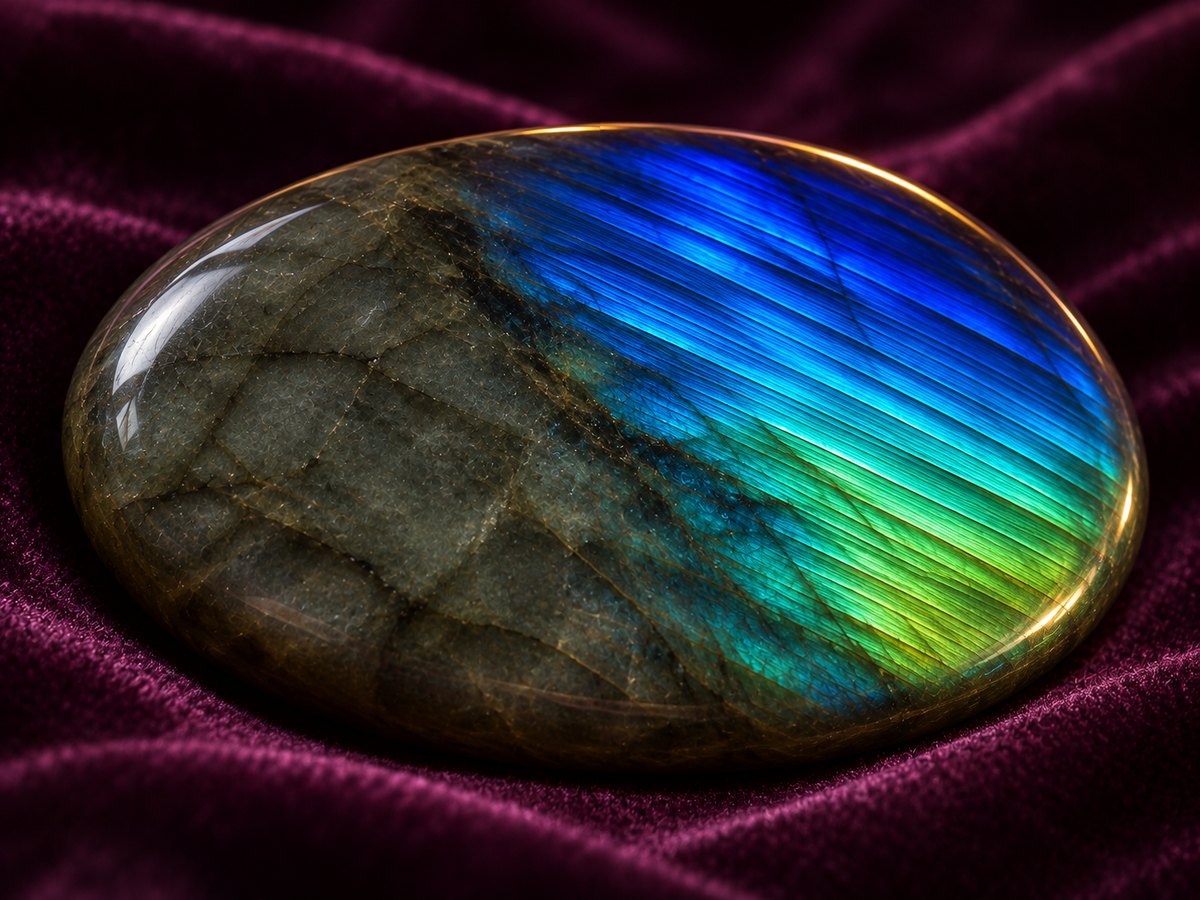
Labradorite meaning begins with a trick of light. Pick up a polished piece and it looks like plain gray stone. Tilt it a few degrees and a sheet of electric blue, green or gold sweeps across the surface, then vanishes again. That flash has a name, labradorescence, and a real physical cause. It has also given the stone a rich life in crystal lore.
Here is what labradorite is, how the flash works, what people believe it means, how they use it, and how to care for it and avoid fakes.
What labradorite is
Labradorite is a feldspar, a member of the plagioclase series. According to Geology.com, written by geologist and GIA graduate gemologist Hobart M. King, its chemistry is (Na,Ca)(Al,Si)4O8, a sodium-calcium aluminum silicate, and it is usually found in dark igneous rocks such as basalt, gabbro and norite. It is also found in anorthosite, a rock in which labradorite can be the most abundant mineral.
The same source lists its Mohs hardness at about 6 to 6.5 and notes two directions of perfect cleavage meeting at roughly 86 degrees. That matters for care: labradorite is a little softer than quartz, and it can split along those cleavage planes if knocked the wrong way.
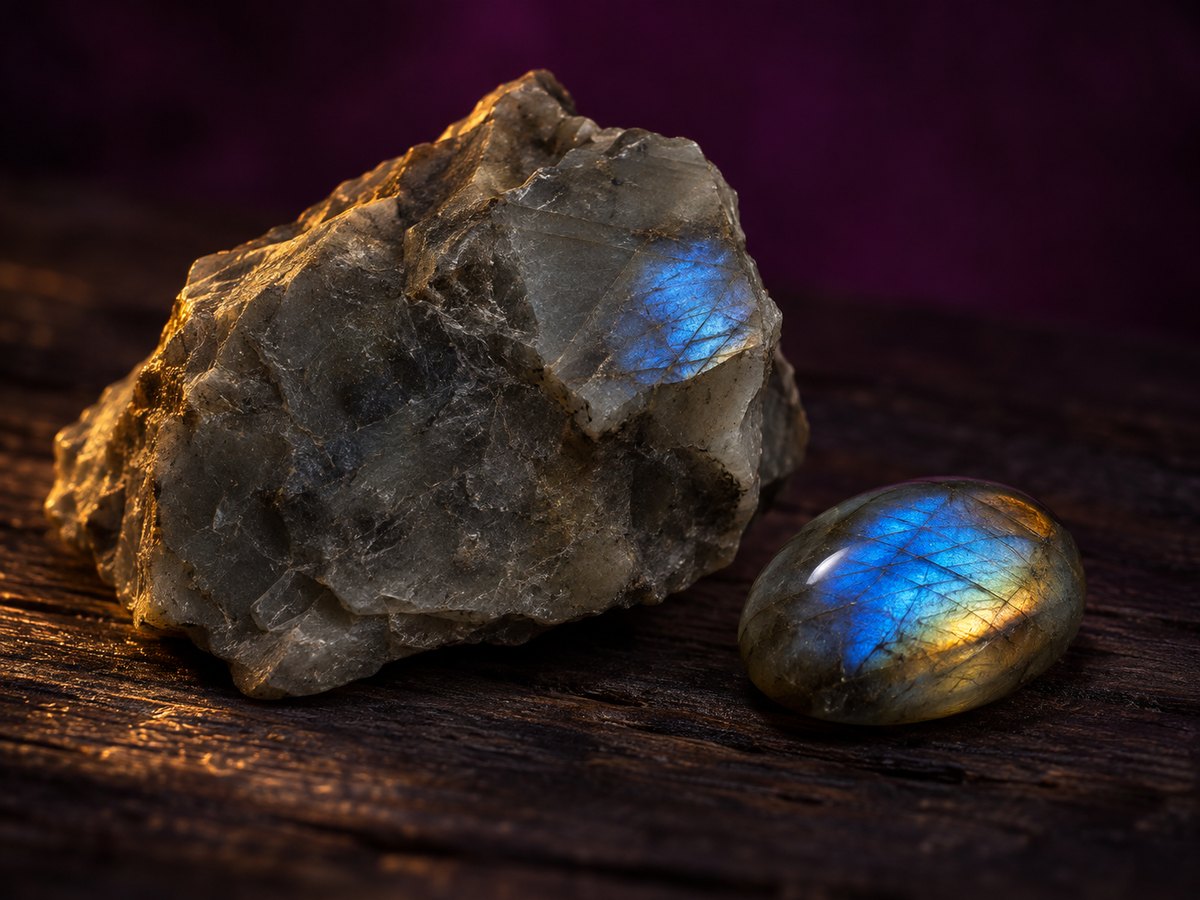
What labradorescence is, and why it flashes
The color in labradorite is not pigment. It comes from structure. As the feldspar cooled very slowly deep underground, it separated into extremely thin, alternating layers of two slightly different feldspar compositions. Light bounces off the boundaries between those layers, and the reflected waves overlap and reinforce certain colors. This is the same kind of interference that colors a soap bubble.
The Summer 2025 issue of Gems & Gemology, GIA's research journal, gives the details. It calls the layered texture the Bøggild intergrowth: alternating wider calcium-rich layers of roughly 70 to 200 nanometers and thinner sodium-rich layers of about 50 to 100 nanometers. The color depends on thickness. According to the journal, a combined thickness of about 150 nanometers produces blue, more than 250 nanometers produces red, and the full spectrum appears in between. That is why blue and green are common and fiery orange and red are rare.
Because the layers lie in one direction, the flash only appears when light and your eye line up with them. Turn the stone and the color goes dark. Geology.com explains that cutters must orient a cabochon so its base is parallel to the layers to get full "face-up color," and that a stone cut at another angle will show its flash off-center.
Why the base color varies
The same GIA paper explains that labradorite's body color comes mainly from tiny iron oxide inclusions. In dark material, such as Finnish spectrolite, the flash sits close to the surface. In nearly inclusion-free, transparent material, the color glows from deeper inside the stone.
Labradorite meaning in crystal lore
The stone takes its name from Labrador, Canada. According to Geology.com, it was discovered in 1770 by a Moravian missionary on the Isle of Paul, near Nain. The gem education site Gem Rock Auctions notes that it is the official mineral of the province of Newfoundland and Labrador.
The most famous story about it is a widely retold legend, usually credited to the Inuit of Labrador: the northern lights were once trapped in the coastal rocks, a warrior freed most of them with a blow of his spear, and the light that stayed behind still flickers in the stone. Gem Rock Auctions records nicknames that grew from this image, such as "Stone of Magic" and "Aurora Borealis Gemstone." Read the details as folklore that has been passed along and reshaped, not as documented history.
In modern crystal tradition, labradorite is linked with transformation, intuition and imagination. Many people see the stone itself as the lesson: something that looks ordinary until the light hits it just right. Practitioners often call it a stone for times of change, a reminder of hidden potential and of the patience it takes to see it. These are beliefs and symbols, and they are a big part of why people love it.
Spectrolite, rainbow moonstone and other names
Labradorite travels under several names, and knowing them helps you shop honestly.
- Spectrolite. GIA describes spectrolite as a rare, highly prized variety of labradorite from Finland, known for rich, full-spectrum color, often several colors at once on a nearly black body. Geology.com notes the name was given by the director of the Geological Survey of Finland, and that exceptional labradorite from elsewhere is now often sold as "spectrolite" too.
- Rainbow moonstone. According to GIA's moonstone page, the pale stone sold as rainbow moonstone is actually a variety of labradorite, not true moonstone, which is a different feldspar called orthoclase. It is lovely, just mislabeled by tradition.
- Countertop labradorite. GIA's 2025 review notes that labradorite rock is often used as high-end countertop material, and names Canada, Finland and Madagascar as sources of the finest iridescent labradorite. Geology.com adds that much gray-to-black labradorite with good flash comes from Madagascar and Russia.
How people use labradorite
- As a meditation focus. Many people simply watch the flash come and go as they slowly turn a palm stone. Moving light is an easy thing to rest your attention on.
- As jewelry. Cabochon pendants and rings are popular, partly because the flash looks alive as you move.
- On an altar or desk. A polished freeform or slab placed where a lamp or candle catches it becomes a small show every evening.
- For journaling and intention. Because of its transformation symbolism, some people hold labradorite while writing about a change they are going through or hoping for.
For people building a bigger space around that kind of practice, iPyramids makes sacred-geometry harmonizers and one-of-a-kind amulets; a few are shown under this article's introduction.
When buying, always see the stone move. Ask for video, or tilt it under a single light in the shop. Look for which direction gives the strongest flash and whether that matches how you will wear or display it.
How to cleanse and care for labradorite
Its hardness and cleavage set the rules. Gem Rock Auctions warns that bumping a labradorite ring at the right angle could break the stone, and suggests protective settings for rings. For cleaning, the same source recommends mild soap, warm water and a soft brush, then a rinse, a dry with a microfiber cloth, and storage apart from other gems. We would also skip ultrasonic and steam cleaners and salt scrubs, simply because a stone with perfect cleavage is not worth the risk.
Store labradorite in a soft pouch, away from quartz and other harder stones that can scratch its polish. Many people also "cleanse" it in the energetic sense with moonlight, sound or intention. Those are rituals, and they will not harm the stone.
How to spot fake labradorite
- Watch the flash move. Real labradorescence is directional. Gem Rock Auctions advises that if the color flashes appear at every angle as you rotate the stone, it is probably a fake.
- Look into, not onto. GIA's photomicrographs show tiny opaque inclusions floating over the blue color, evidence that the color always comes from inside the crystal. A stone whose color seems painted on top, rather than glowing from within, deserves a closer look.
- Expect a gray stone. Real labradorite looks dull gray, greenish or near-black when the flash is off. A piece that is bright blue from every side deserves questions.
- Check the name. Pale "rainbow moonstone" is labradorite, which is fine. A dark stone called "moonstone," or anything with a trade name you don't recognize, is worth asking about.
Who should be careful
Children and pets should not have access to small tumbled stones or beads. Our guide to water-safe crystals lists labradorite among the feldspars with natural planes of weakness, so keep soaking brief and never put it in drinking water. And like every crystal, it is a symbol and a beautiful object, not a substitute for professional help when you need it.
Quick answers
What does labradorite mean?
In crystal lore, labradorite is linked with transformation, intuition and imagination. A widely retold northern-lights legend gave it nicknames like Stone of Magic. These are traditional meanings and symbols, not properties of the mineral.
What causes the flash in labradorite?
According to GIA, labradorite contains extremely thin alternating layers of two feldspar compositions. Light reflecting between those layers interferes and reinforces certain colors, so the stone flashes blue, green, gold or red only at certain angles. This is called labradorescence.
Is rainbow moonstone the same as labradorite?
Yes, mineralogically. GIA notes that the pale stone sold as rainbow moonstone is a variety of labradorite, not true moonstone, which is orthoclase feldspar. Spectrolite, a dark and very colorful labradorite from Finland, is another trade name.
How do I clean labradorite?
Use mild soap, warm water and a soft brush, rinse and dry with a soft cloth, and store it apart from harder stones. Its hardness of about 6 to 6.5 and perfect cleavage mean a hard knock can chip or split it, so avoid harsh cleaners and protect rings.