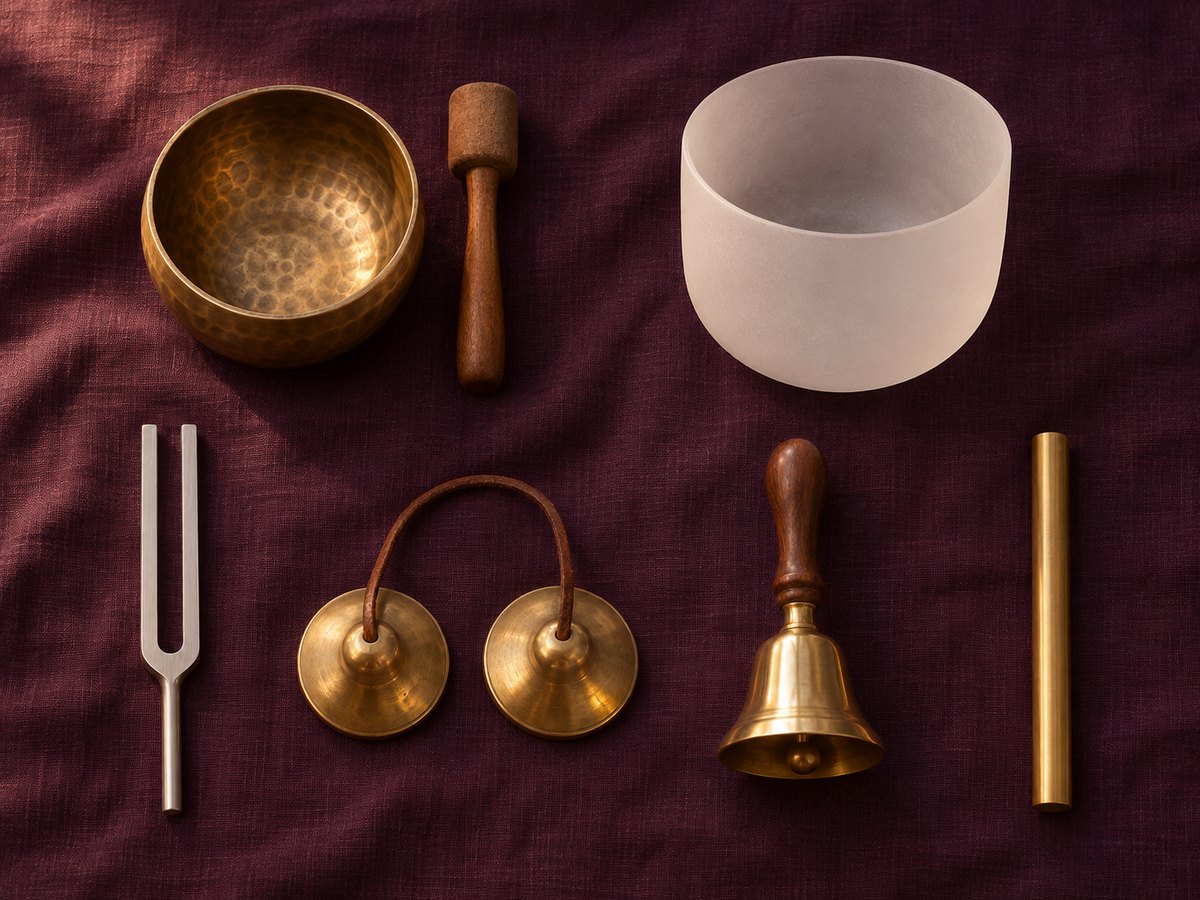
Walk into any sound bath and you will see a little orchestra laid out on the floor: bowls in a row, a gong on a stand, a few small bells and chimes within reach. Each one makes a very different kind of sound, and each one has its own history. This tour walks through the main families, what they are made of, how they are played, and what to think about before you bring one home.
A quick map of sound healing instruments
Almost every instrument in a sound bath is an idiophone: a solid object that makes sound by vibrating itself, with no strings or skins. The differences come down to shape and material.
- Bells and bowls vibrate most around their open rim. Wikipedia's article on standing bells classifies singing bowls as a kind of bell for exactly this reason.
- Gongs do the opposite; the same article notes a gong vibrates most toward its center.
- Forks and chimes are bars or tubes that ring at a fairly pure pitch set by their length and material.
In sound healing circles, practitioners pair these instruments with intentions, chakras or moods. Those meanings come from tradition and personal practice. What follows sticks to what the instruments are and how they are played, so you can choose the sound you enjoy.
Singing bowls: metal and crystal
Metal singing bowls
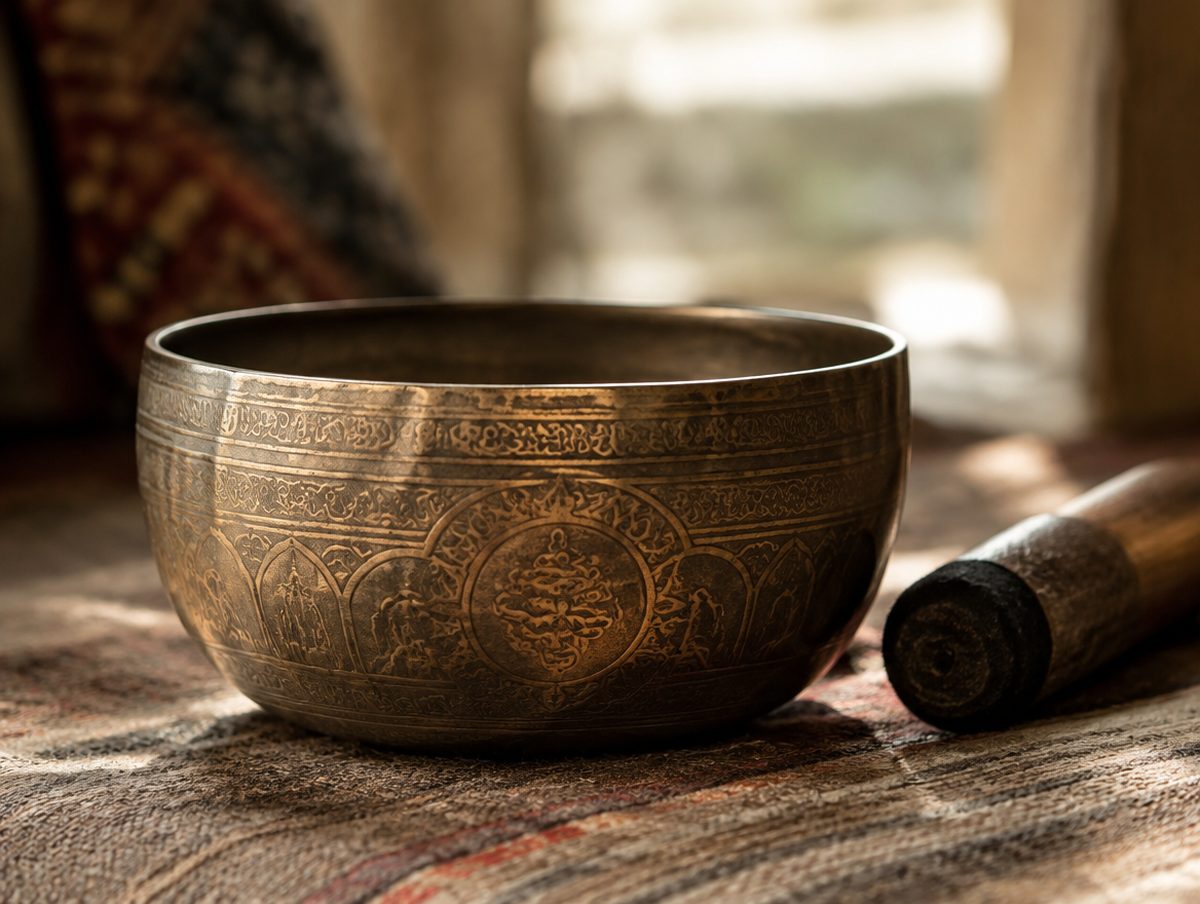
Metal bowls are the instrument most people picture first. According to Raven Sounds' guide to singing bowl materials, traditional bowls are made of bell-metal bronze, roughly 78% copper and 22% tin. The same guide calls the popular "seven sacred metals" story largely a marketing myth, since published metal analyses keep finding copper and tin. Brass bowls, made of copper and zinc, are usually brighter and fade sooner.
Their history is more modern than the labels suggest. Wikipedia's standing bell article notes that historical accounts of Tibetan music are silent about singing bowls, and that many bowls sold as Tibetan actually come from northern India or Nepal. They are still beautiful instruments; the name is a style, not proof of origin.
Crystal singing bowls
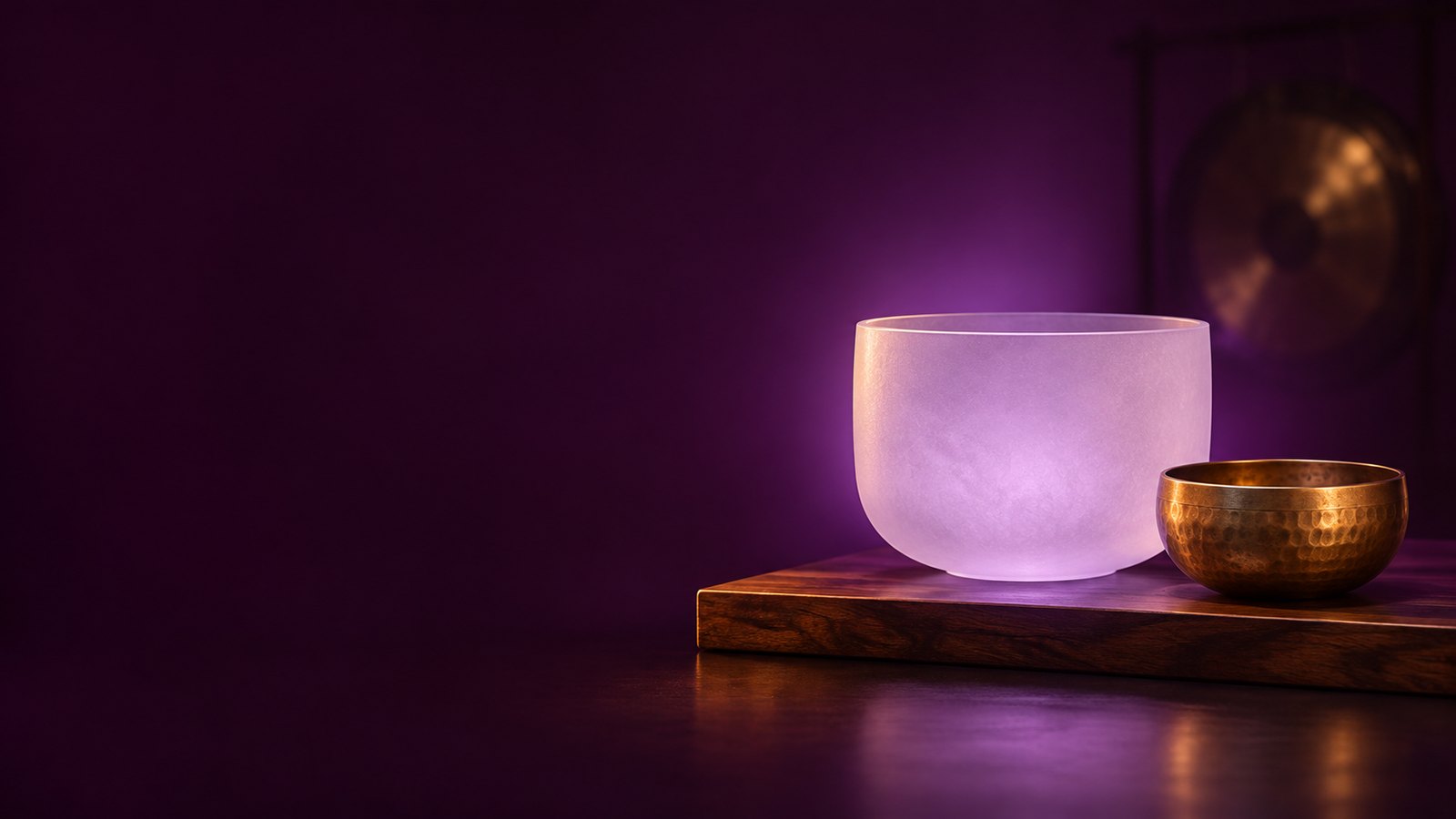
Crystal bowls are a modern invention. Kripalu's guide explains that frosted crystal bowls are made from crushed quartz heated to around 4,000 degrees in a spinning mold, while clear bowls are formed in a high-temperature mold with pressurized air. They sound louder and purer than most metal bowls, and they are far more fragile.
We sell our own crystal bowls, and you can see the range in our shop. If you are new to bowls, our guide to singing bowls for beginners covers sizes and mallets in detail.
Tuning forks
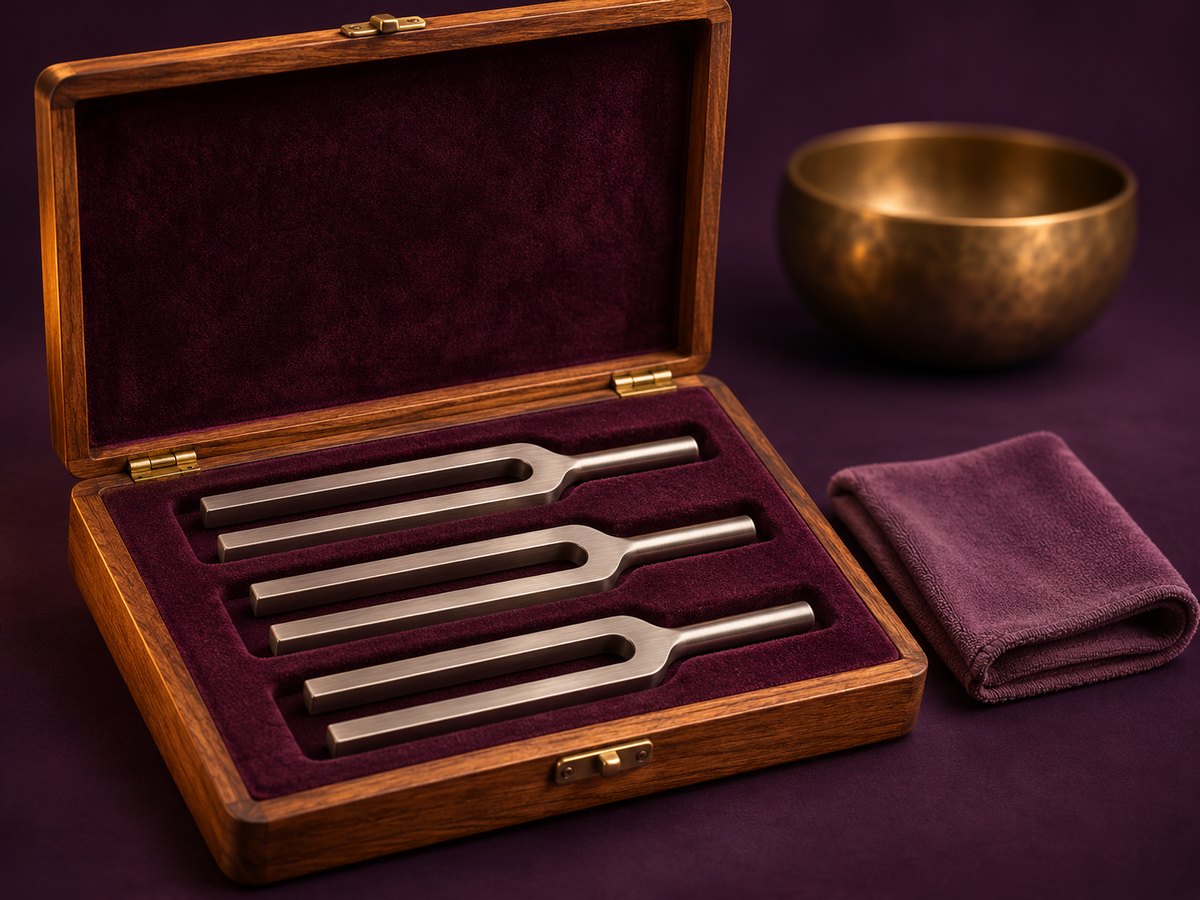
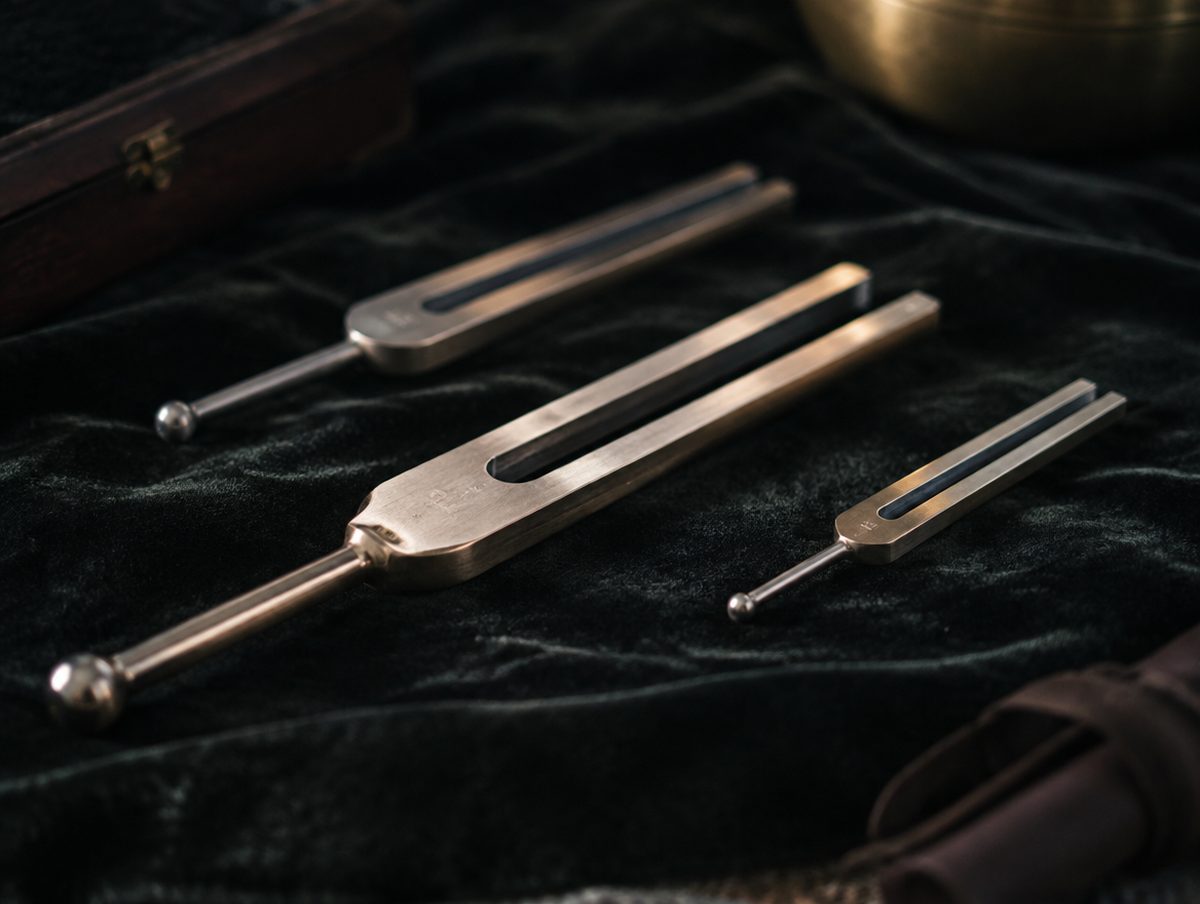
According to Wikipedia, a tuning fork is a two-pronged fork of elastic metal, usually steel, whose pitch depends on the length and mass of its prongs. Tap it and it rings one clear note. Practitioners divide them into unweighted forks, which you listen to, and weighted forks, with small weights on the tines, which are often rested lightly on the body so the vibration is felt more than heard.
Sets are usually built around a theme, such as an octave tied to the seven chakras or the much-discussed A 432 Hz. Our full tuning forks guide explains weighted vs unweighted forks, the common sets and the 432 vs 440 Hz story. Always strike a fork on a rubber puck or your knee, never a table.
Chimes, bells and gongs
Chimes
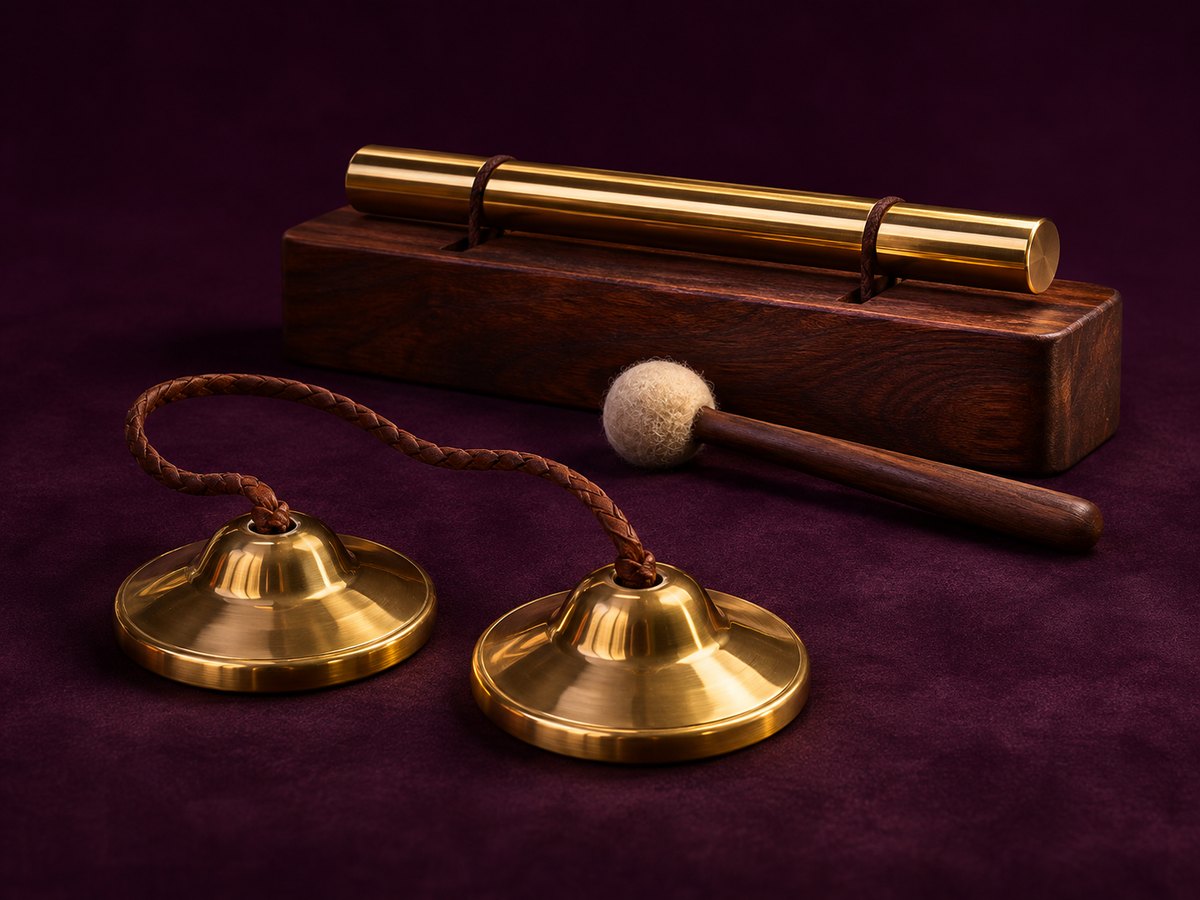
Chimes are tubes or rods that ring when struck. Wikipedia's wind chime article explains that the tube itself radiates the sound, so its length and material set the pitch rather than the air inside it, and that aluminum is popular because it has the lowest internal damping of the common metals, giving a long, loud ring. Hand-held chime bars mounted on small wooden boxes let you strike a single clear note on purpose.
Tingsha and hand bells
Tingsha are a pair of small, thick cymbals joined by a leather strap or chain. According to Wikipedia, they are used in prayer and ritual by Tibetan Buddhist practitioners, typically measure 2.5 to 4 inches across, and give a clear, high, long-ringing tone when struck together. Many practitioners use them, or a small hand bell, to mark the start and end of a session.
Gongs
Gongs are the biggest voice in the room. Wikipedia's gong article says they are made mainly from bronze or brass and fall into three broad types: flat suspended discs, gongs with a raised central boss, and bowl gongs that rest on cushions. In orchestras, the large flat type is called a tam-tam. The article also notes that some gongs are loud enough to be heard up to eight kilometers away, a good reminder to play them gently indoors. Larger gongs take larger, softer mallets.
Tuned meditation bells
Some modern makers tune bells and fork sets to specific frequencies. iPyramids, for example, lists its Solar Bell as tuned to A 432 Hz and its Sound Swords as a chakra tuning-fork set, with forks from G 384 Hz for the throat chakra up to B 487 Hz for the crown in their scheme. Tuned pieces like these are about the listener's preference and tradition; enjoy the tone you are drawn to.
Frequency players and recorded sound
Not every instrument in a modern practice is acoustic. Many people play recorded tones, binaural tracks or nature sounds through speakers, and some use dedicated frequency players loaded with tracks for meditation. The same maker sells a small player with preloaded frequency tracks designed to work with its iTorus coils; you can see it in the sound and frequency tools section.
Recorded sound is a good way to try a sound before you buy an instrument, and it lets you practice when you cannot make noise at home. Just keep the volume comfortable, especially with headphones.
Choosing, playing and safety
How to choose your first instrument
- Start with one. A small or medium metal bowl or a single tuning fork is affordable, durable and easy to learn.
- Listen first. Ask for a recording or play in person. Tone matters more than looks.
- Think about space. Crystal bowls and gongs fill a room fast. In an apartment, a metal bowl or chimes may suit better.
- Check the details. Look for a stated material and place of manufacture, a cushion or ring for bowls, and a proper mallet or striker.
Safety and care
- Protect your hearing. According to the CDC's NIOSH noise page, 85 decibels (A-weighted) is the level where precaution starts, and a sound that makes you raise your voice to be heard by someone 3 feet away is about that loud. If your ears ring afterwards, it was too loud. Play gongs and large crystal bowls softly and keep your head out of their direct path.
- Handle crystal with care. Carry crystal bowls with two hands, set them on a soft ring, and never stack them.
- Check first if you need to. If you are sensitive to sound, have ringing in your ears, have an implanted device such as a pacemaker, or are pregnant, ask your doctor before resting vibrating instruments on your body or joining a loud session, and tell the practitioner.
- Keep metal dry. Wipe bronze and brass with a soft cloth after playing. A little darkening is normal patina.
For what to expect when you join a group session, read our guide to what a sound bath is.
Quick answers
What are the main sound healing instruments?
The most common are metal and crystal singing bowls, tuning forks, chimes and chime bars, tingsha cymbals, hand bells, gongs and tuned meditation bells. Many practitioners also use recorded tones played through speakers or a frequency player.
What are crystal singing bowls made of?
Most are fused quartz. Frosted bowls are made from crushed quartz sand heated to around 4,000 degrees in a spinning mold, and clear bowls are formed in a hot mold with pressurized air. They are louder and much more fragile than metal bowls.
Which sound healing instrument should a beginner buy first?
A small or medium metal singing bowl or a single tuning fork is an easy, affordable start. Both are durable, quiet enough for most homes and simple to play. Listen to a recording first and choose the tone you enjoy.
Can sound instruments be too loud?
Yes. The CDC's NIOSH guidance sets 85 A-weighted decibels as the level where precaution starts, roughly when you must raise your voice to be heard 3 feet away. Play gongs and large crystal bowls softly, and stop if your ears ring.