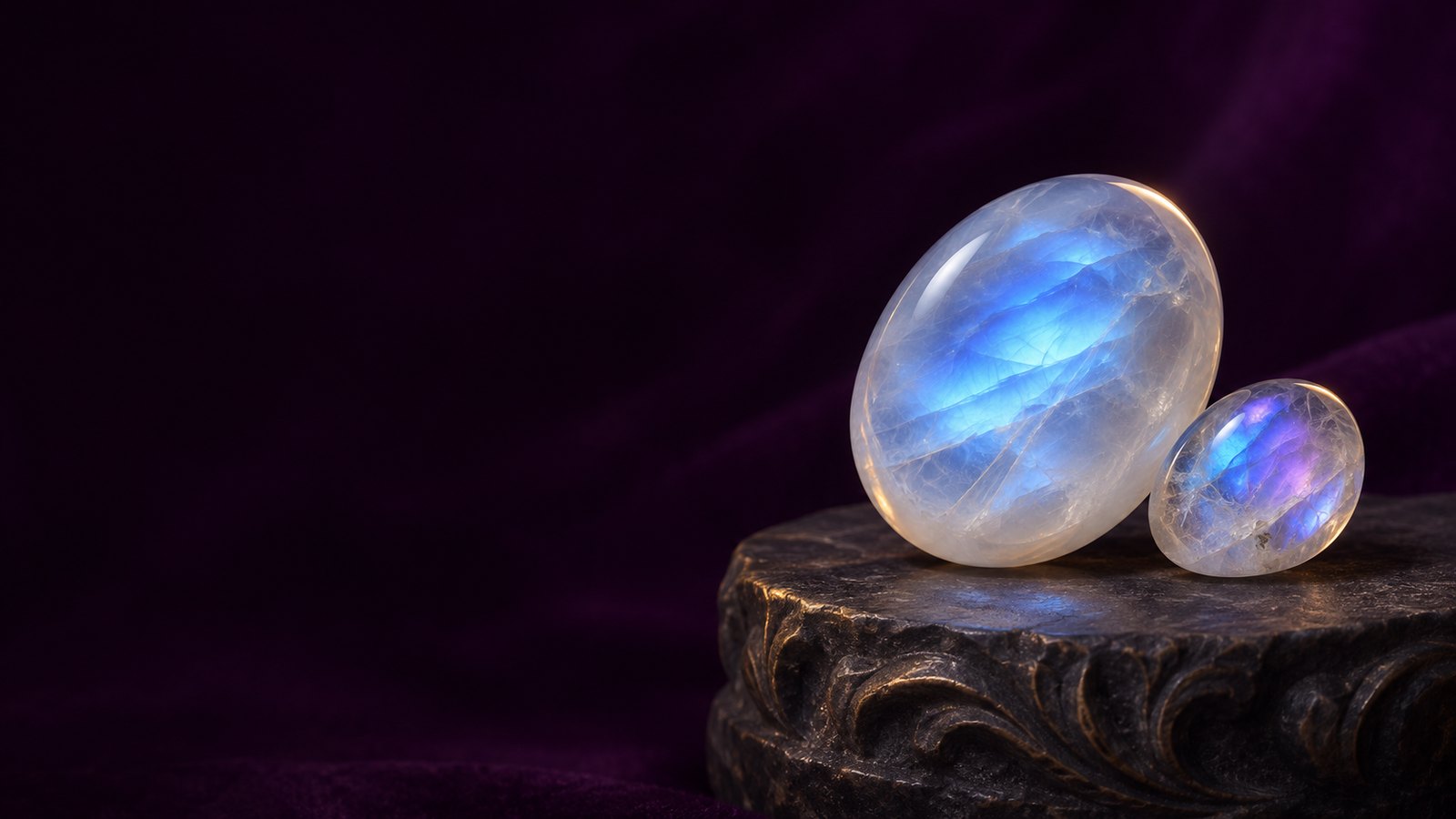
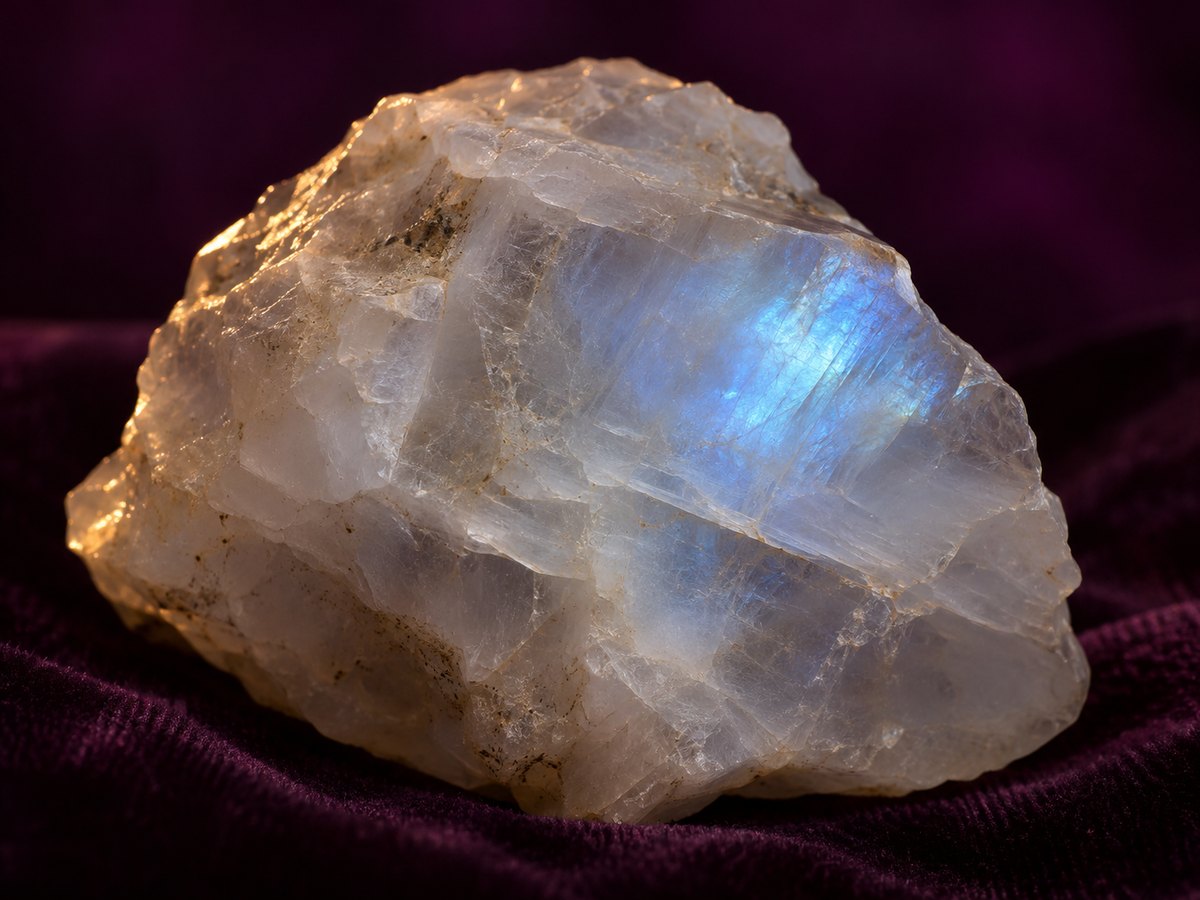
Moonstone looks like it holds a little piece of the night sky. Turn a good cabochon slowly and a soft, bluish-white light seems to float just under the surface, drifting from one side of the stone to the other. No wonder nearly every culture that met it tied it to the moon. That glow has a name, adularescence, and a precise physical cause.
What moonstone is
Moonstone is a feldspar, part of the mineral family that, according to GIA, makes up more than half of the Earth's rocky crust. GIA describes classic moonstone as a variety of orthoclase, a potassium aluminum silicate (KAlSi3O8), and lists its Mohs hardness at 6 to 6.5. It comes in more colors than most people expect: GIA names colorless to white, gray, green, peach and brown body colors, with blue, silver, white or rainbow sheen. The most valued stones show a blue sheen against a nearly colorless body.
According to GIA's June birthstone guide, the most important sources are India and Sri Lanka, with others in Brazil, Madagascar, Myanmar and Tanzania, and smaller finds in New Mexico, North Carolina and Virginia. GIA also notes that in 1997 miners in southern India found a moonstone with a bright "parrot green" body color.
Moonstone is also a modern birthstone. GIA lists it for June, alongside pearl and alexandrite.
Adularescence: the moving glow
The glow is not a pigment or a coating. It comes from structure. GIA explains that moonstone forms as two feldspar minerals, orthoclase and albite, mixed together. As the newly formed mineral cools, they separate into thin, flat, alternating layers stacked like the pages of a book. When light falls between those layers, it scatters in many directions. That scattered light is adularescence, which GIA describes as light that appears to billow across a gemstone, giving its surface a glowing look.
The layers are astonishingly thin. GIA notes they are about 0.5 microns thick, similar to a wavelength of light. Geology.com, in a guide by geologist Hobart M. King, adds that because the layers differ slightly in composition, they bend light a little differently, so light is bent, reflected and scattered at each boundary as it passes through. The result is a glow that seems to move as you change the angle, like the full moon seen through thin, high cloud.
The name has history too. According to GIA, adularescent moonstone was once called "adularia," after Mt. Adular in Switzerland (now St. Gotthard), one of the first sources of fine material.
Rainbow moonstone vs feldspar moonstone
Here is where shoppers get confused. The pale stone sold as "rainbow moonstone," with flashes of blue, purple and gold, is not orthoclase at all. GIA states that it is a variety of labradorite, a different feldspar, found especially in Madagascar, and that the trade has accepted it as a gem in its own right. Mineralogically, it is a close cousin of the labradorite in our labradorite meaning guide, with a light body color instead of a dark one.
- Classic moonstone (orthoclase): a soft, single-color glow, usually white, silver or blue, that floats across the stone.
- Rainbow moonstone (labradorite): a white body with colorful, multi-hued flashes.
Both are natural feldspars, and both are lovely. The distinction matters mainly for price and honest labeling. GIA even notes that, for the name moonstone, the beauty of the adularescence has historically mattered more than the exact mineral.
Moonstone meaning in crystal lore
Few stones carry their meaning so plainly in their name. According to GIA, Hindu mythology holds that moonstone is made of solidified moonbeams, and the stone has been linked with both the Roman and Greek lunar deities. GIA also records the old legend that moonstone brings good luck, and that some believed you could glimpse the future by holding one in your mouth under a full moon, a story best left as folklore.
The stone has had its fashion moments too. GIA notes that Art Nouveau designers such as René Lalique and Louis Comfort Tiffany featured it, and it returned in the 1960s and again with New Age designers of the 1990s.
In modern crystal tradition, moonstone is associated with:
- Cycles and new beginnings. Like the moon, it is seen as a symbol of change that comes in its own time.
- Intuition and reflection. Its soft, inward light makes it a favorite for quiet, reflective practice.
- Love and luck. GIA notes the stone is often associated with love and passion and is believed to bring great luck.
- The feminine and the moon. Many practitioners link it with lunar goddesses and moon rituals.
In chakra tradition, moonstone is most often placed with the third eye and crown, and in astrology lore it belongs to Cancer, the sign ruled by the moon. These are beliefs and symbols, and they are a big part of why people love it.
How people use moonstone
- In moon rituals. Many people set moonstone out on a windowsill under the full or new moon, or hold it while writing intentions for the coming cycle.
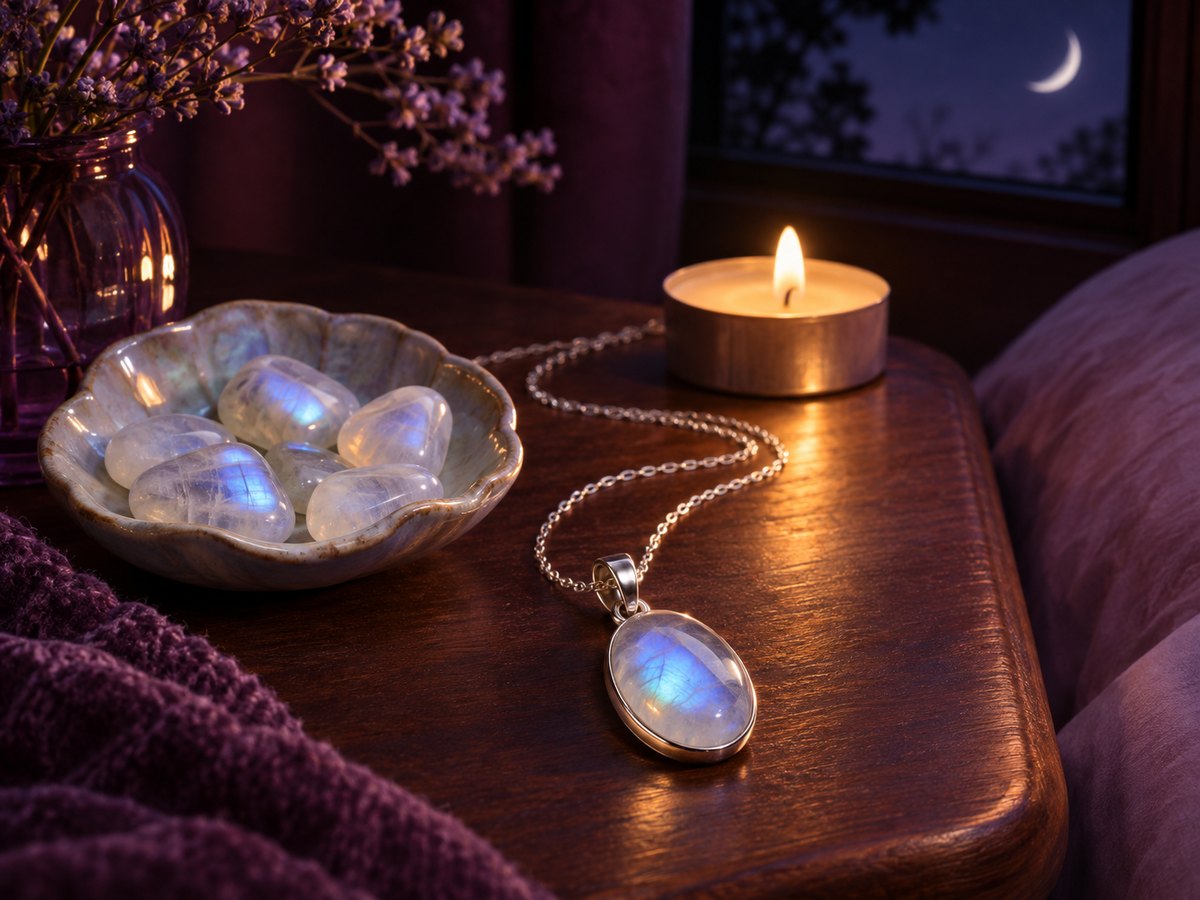
- As jewelry. Pendants and earrings are the gentlest choice. A pendant is far less exposed to knocks than a ring.
- As a meditation focus. Slowly turning a cabochon and watching the glow drift is a simple way to rest your attention.
- On a bedside table or altar. Its quiet, silvery look suits evening spaces and candlelight.
For people building a larger space for moon and meditation practice, iPyramids makes pyramid frames you sit inside; you can see them in the pyramid collection, and a few pieces are shown under this article's introduction.
How to cleanse and care for moonstone
Moonstone is lovely but delicate, and its care rules come straight from its structure. GIA's birthstone guide rates it 6 to 6.5 in hardness with poor toughness, warns that it may crack with high heat, and says ultrasonic and steam cleaners should not be used. Its recommendation is warm, soapy water and a soft brush. Geology.com adds that moonstone has two directions of perfect cleavage, so one sharp impact against a hard surface can split a stone in two.
- Clean gently: warm water, a drop of mild soap, a soft brush, a quick rinse, and dry right away.
- Never soak it. Our guide to water-safe crystals lists moonstone among the feldspars with natural planes of weakness, so keep contact with water brief.
- Protect rings. GIA advises against wearing moonstone rings for sports or the gym, and a protective bezel setting helps.
- Store it alone. Quartz and other harder stones can scratch its polish, so keep it in a soft pouch of its own.
Moonlight cleansing, the favorite ritual for this stone, needs no water at all: many people simply leave it on a sill overnight.
How to spot fake moonstone
- Watch the glow move. Real adularescence floats and shifts as you tilt the stone. A glow that sits flat and looks the same from every angle deserves a closer look.
- Beware of "opalite." The International Gem Society describes opalite as a trade name for a glass often used to simulate moonstone or opal. It is pretty, but it is manufactured glass, and it is sometimes sold with names that include "moonstone."
- Look for natural features. GIA notes that moonstone's most typical inclusions are tiny stress cracks called "centipedes," named for their many-legged look. A perfectly flawless "moonstone" at a low price, is a reason to ask questions.
- Check the label. "Rainbow moonstone" is labradorite, which is fine if you know it. Ask the seller what the mineral is.
Who should be careful
Keep small beads and tumbled stones away from young children and pets. Moonstone is not a stone for drinking-water rituals, both because it is fragile in water and because no stone needs to be in what you drink. And like every crystal, it is a symbol and a beautiful object, not a substitute for professional help when you need it.
Quick answers
What does moonstone mean?
In crystal lore, moonstone is linked with the moon, cycles, new beginnings, intuition, love and luck. Hindu mythology says it is made of solidified moonbeams. These are traditional meanings and symbols, not properties of the mineral.
What causes moonstone's glow?
According to GIA, moonstone contains extremely thin, alternating layers of two feldspars, orthoclase and albite. Light scattering between those layers creates adularescence, a soft glow that seems to billow across the stone as you move it.
Is rainbow moonstone real moonstone?
Not mineralogically. GIA says rainbow moonstone is a light-colored variety of labradorite, a related feldspar, while classic moonstone is orthoclase. The trade accepts rainbow moonstone as a gem in its own right; just know what you are buying.
Can moonstone go in water?
Only briefly. GIA rates moonstone 6 to 6.5 with poor toughness and advises against ultrasonic and steam cleaners. Clean it with warm, soapy water and a soft brush, rinse quickly, dry it right away, and never soak it.