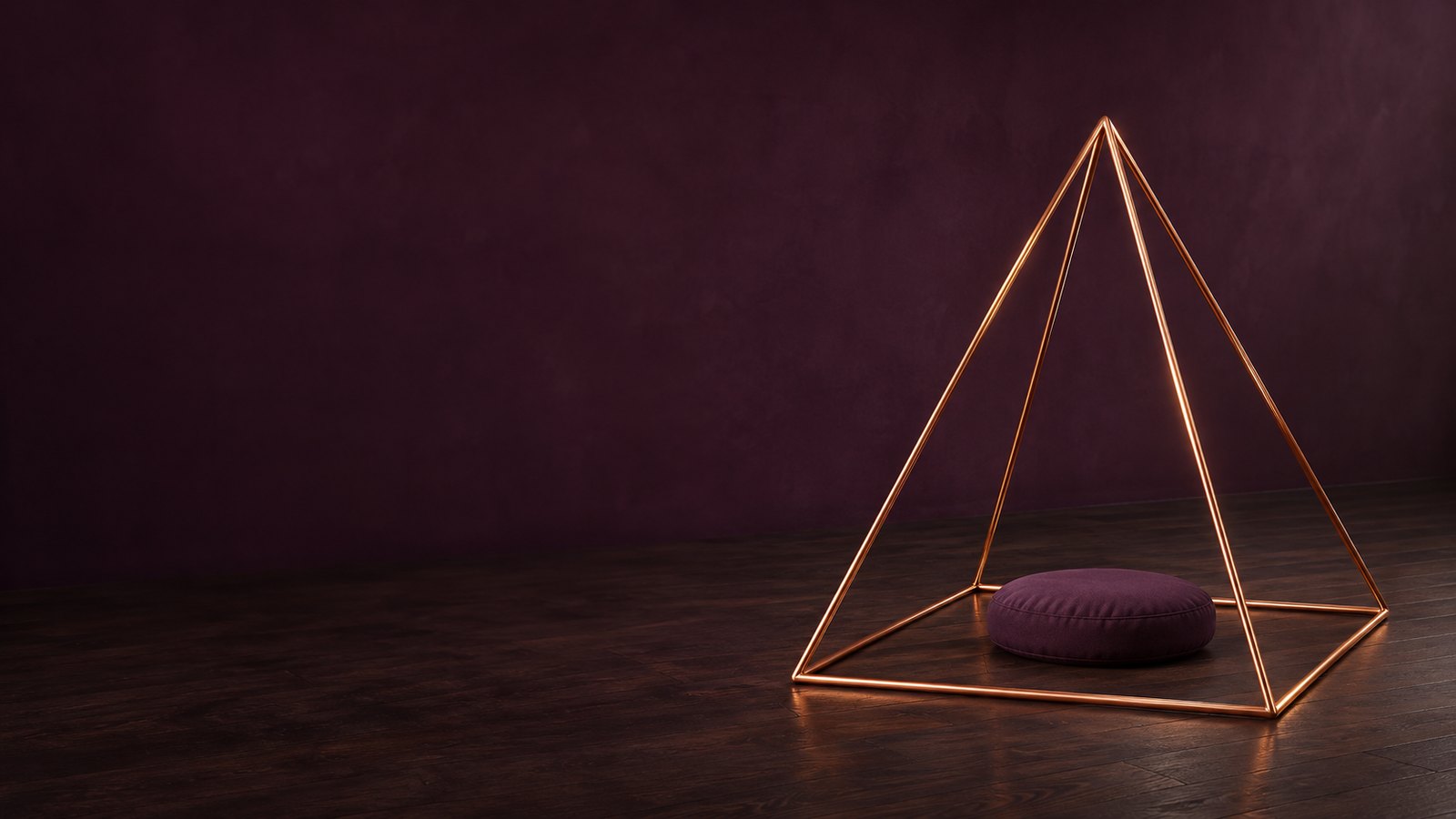
An open pyramid frame is one of the simplest shapes you can bring into a room: four sloping edges, a square base and a point at the top, with nothing to block the light or the air. Sitting under one is a quiet ritual for many people, and the story of how the shape got its reputation is half the fun.
This guide covers that history honestly, then gets practical: how people actually meditate under a frame, how copper compares with other metals, how to size a frame for your room, and how to keep it steady on the floor.
Where pyramid-shape beliefs come from
The modern idea that the pyramid shape itself does something is younger than most people expect. According to Wikipedia's article on pyramid power, a French ironmonger and pendulum-dowsing author named Antoine Bovis developed the idea in the 1930s that small model pyramids could preserve food. The popular story says he got the idea inside the Great Pyramid, but the same article notes that Bovis never claimed to have visited Egypt; his own booklet credits dowsing experiments in Europe.
The idea traveled. In 1949, inspired by Bovis, the Czechoslovak Karel Drbal applied for a patent on a "Pharaoh's shaving device," a small cardboard pyramid meant to keep razor blades sharp. Wikipedia records that the writers Sheila Ostrander and Lynn Schroeder met Drbal in 1968 and gave pyramid power a chapter of their 1970 book Psychic Discoveries Behind the Iron Curtain, which carried the idea to English-speaking readers.
By the mid-1970s it was a full craze. TIME magazine's "Modern Living: Pyramid Power" column described cardboard razor-blade pyramids, and the inventor Patrick Flanagan selling a vinyl "Cheops Pyramid Tent" promoted as a setting for meditation and yoga. The same TIME piece was frank that no firm scientific evidence existed to prove or disprove pyramid power. That is still the fair summary: pyramid meditation is a practice built on belief and personal experience, not on measured effects.
How people practice pyramid meditation
There is no single official method, and that is part of the appeal. Most practitioners describe something like this:
- Sit near the center. Many people place a cushion or low chair so they sit directly under the apex.
- Face a direction on purpose. Flanagan's later book Beyond Pyramid Power told builders to buy a compass and line their pyramids up with magnetic north. Plenty of people still align one side to north; others simply face the window or their altar.
- Keep it short at first. Ten to twenty minutes of quiet breathing, a mantra or a guided track is a comfortable start. Lengthen it only if you enjoy it.
- Add sound if you like. A singing bowl or a single bell at the start and end gives the session a clear shape. Our guide to sound baths has ideas for gentle sound.
Some people say they feel a tingle or a sense of focus under the frame, and others feel nothing in particular but enjoy the ritual of a dedicated space. Both are normal. Think of the frame as a frame for your attention, and let your own experience be the guide.
Copper pyramid vs aluminum, brass and wood
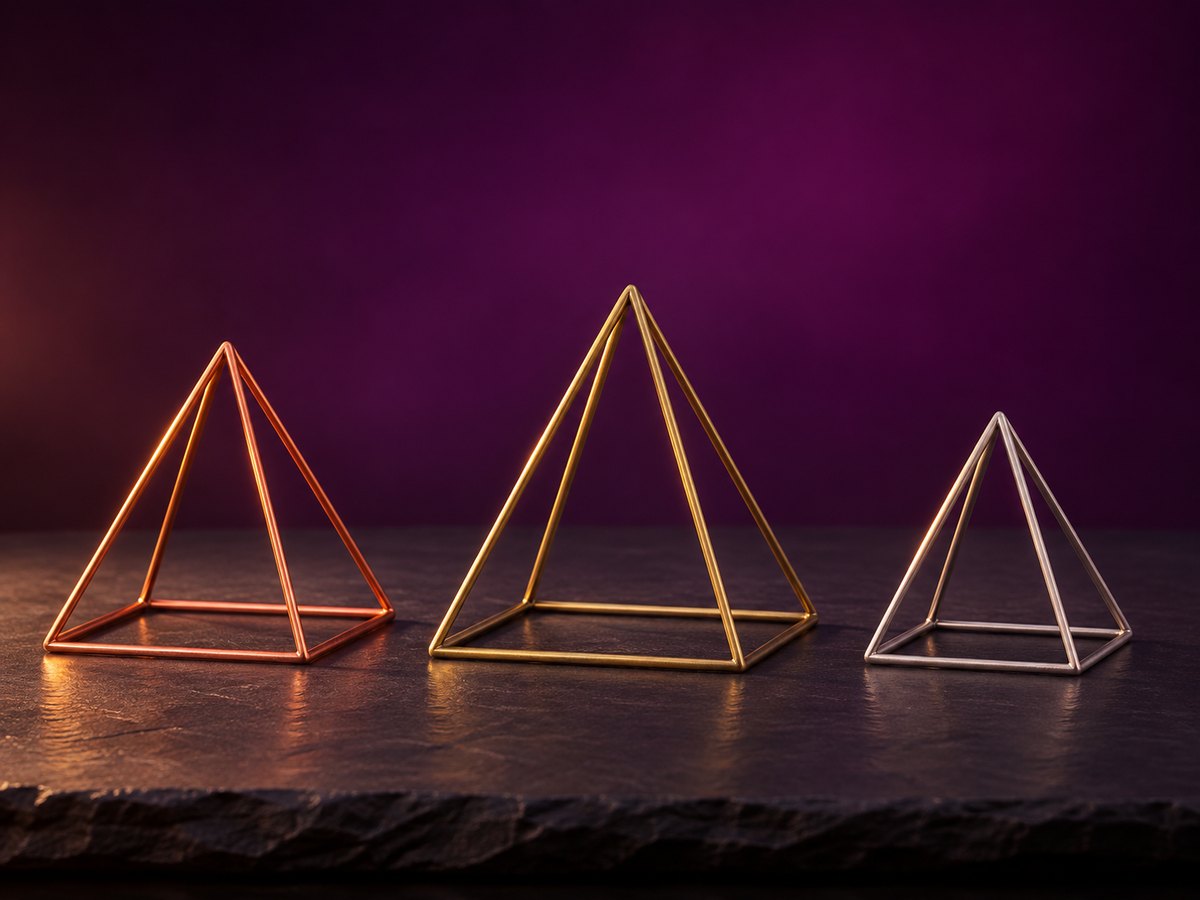
The copper pyramid is the classic choice, but it is not the only one. Flanagan himself wrote in Beyond Pyramid Power that any non-ferrous, non-magnetic material would do, listing cardboard, wood, copper, aluminum, plastic and glass among the materials he used. His own meditation pyramid was an open frame of four six-foot aluminum tubes joined with hardware-store brackets.
Copper
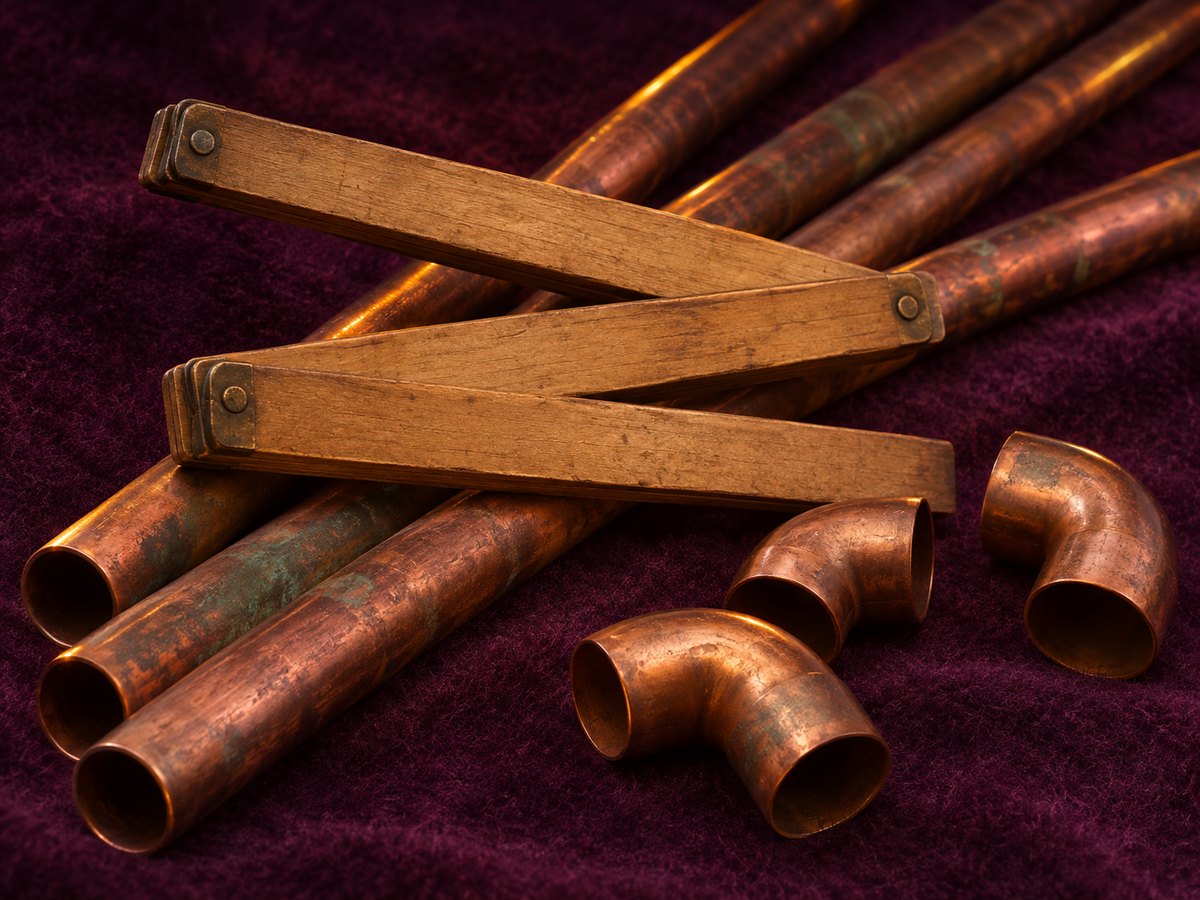
Copper is the favorite in pyramid circles largely for its warmth and its long association with conductivity. Wikipedia's copper entry notes that among pure metals at room temperature, its conductivity is second only to silver. Copper also changes color with age. According to Curious, the Australian Academy of Science's explainer, copper first reacts with oxygen to form reddish then dark oxides, and over time carbon dioxide and water in the air build the familiar blue-green patina. That is cosmetic, not damage; Wikipedia notes the oxide layer actually protects the metal beneath.
Aluminum, brass and wood
- Aluminum is light, cheap and easy to carry from room to room. It stays silver-gray rather than darkening.
- Brass is an alloy of copper and zinc with a yellow-gold color, a middle ground in both look and price.
- Wood gives the softest look and suits a natural room, but thick wooden poles make a heavier frame.
If you want copper to stay bright, wipe fingerprints off with a soft dry cloth after you handle it. If you prefer the deep brown or green look, simply leave it alone. Avoid harsh abrasives on plated frames, which can cut through a thin finish.
Sizing a meditation pyramid to your room
The shape you choose decides how much floor and ceiling you need. Two proportions dominate:
- Giza proportions. According to a University of Washington mathematics page on the Great Pyramid, each face of Khufu's pyramid slopes at 51°50'40", which is why frames are often sold as "51.84 degrees." At that slope, the height works out to a little under two-thirds of the base width. A frame with a 6-foot base stands about 3.8 feet tall; an 8-foot base, about 5.1 feet; an 11-foot base, about 7 feet.
- Nubian proportions. Wikipedia's article on Nubian pyramids describes them as tall, narrow structures inclined at roughly 70°, compared with 40 to 50° for Egyptian pyramids of similar height. A Nubian-style frame needs much less floor but much more height.
Real-world examples make the difference clear. iPyramids lists its Giza i5 frame at an 11 by 11 foot base and 7 feet tall, and its Nubian i5 at a 5 by 5 foot base and 8 feet tall. The two take nearly the same height but very different floor space. You can compare the full range in the pyramids you sit inside section.
Measure before you buy
- Ceiling. The International Residential Code requires at least 7 feet of ceiling height in habitable rooms, according to Fine Homebuilding's guide to IRC minimums. Many older rooms and basements are close to that line, so measure your actual ceiling, and check for beams, fans and light fixtures above where the apex will sit.
- Floor. Add at least a couple of feet of walking space around the base so nobody catches a foot on a corner.
- Seated height. Sit on your cushion and have someone measure from the floor to the top of your head. For a low Giza frame, that number tells you whether you will sit comfortably inside or lean against a pole.
Safety: stable footing comes first
A pyramid frame is a tall, top-light structure standing on four small points. Most problems come from the floor, not the frame.
- Level the floor. Use a spirit level at each corner. A wobble at the base becomes a sway at the top.
- Use non-slip pads. Rubber or felt-backed pads under each foot stop a frame from skating on hardwood or tile and protect the floor from scratches.
- Tighten every joint. Check bolts, brackets and connectors when you first assemble the frame and again every few weeks; tubes settle.
- Mind children and pets. A frame is tempting to climb or swing on. Place it where it will not be bumped, and never let anyone hang from it.
- Get in slowly. Under a low frame, keep a hand on the floor or cushion, not on the frame, as you sit and stand.
- Powered frames need extra care. Some frames carry electromagnetic coils at the top or corners. If you have a pacemaker or another implanted electronic device, or you are pregnant, ask your doctor before sitting inside one, and read the maker's safety sheet.
Making pyramid meditation part of your week
The frame is only the start. What makes the space feel like yours is what you bring into it: a cushion you love, a small altar just outside the base, a favorite crystal or a single candle in a safe holder. Keep the area clear of clutter so the shape stays the focus.
Many people pick one fixed time, such as early morning or just before bed, and keep it simple: sit, breathe, listen, then write one line in a journal about how it felt. Over a few weeks, you will know whether a meditation pyramid is a ritual you want to keep.
Quick answers
What is pyramid meditation?
It is meditation done while sitting under an open pyramid frame, usually on a cushion near the center. The idea grew out of the "pyramid power" beliefs of the 1930s to 1970s. It is a practice built on tradition and personal experience rather than measured effects.
Is a copper pyramid better than aluminum?
Neither is proven better. Copper is the traditional favorite for its warm color and its high conductivity, and it darkens to brown or green over time. Patrick Flanagan, who popularized meditation pyramids, wrote that any non-magnetic material would do and built his own frame from aluminum tubes.
What size meditation pyramid do I need?
At Giza proportions (about 51.8 degrees), height is a little under two-thirds of the base width, so a 6-foot base stands about 3.8 feet tall and an 11-foot base about 7 feet. Measure your ceiling, any beams or fans, and your own seated height before you buy.
Which way should a meditation pyramid face?
Many practitioners line one side up with magnetic north using a compass, a habit that goes back to the 1970s pyramid books. Others simply face a window or altar. Choose what feels right and keep the frame steady and level.