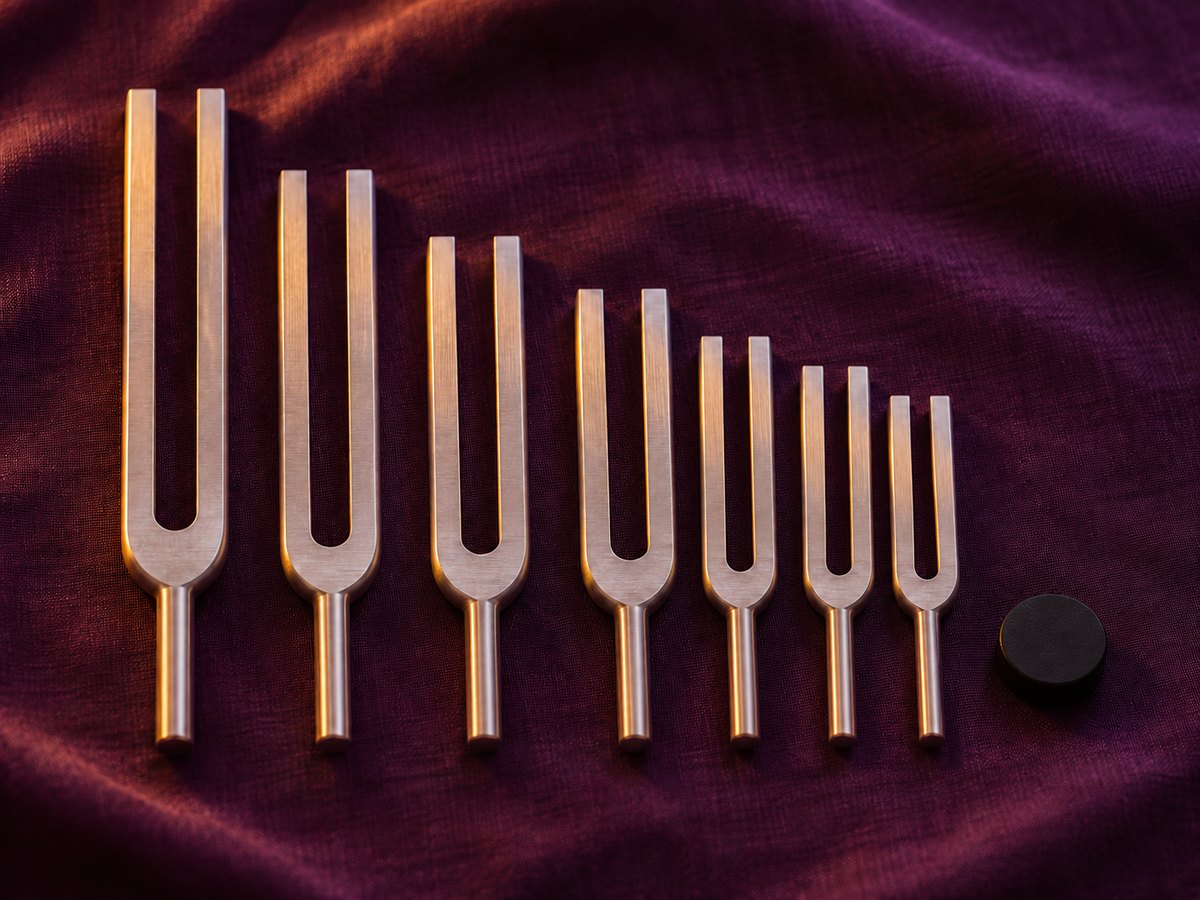
A tuning fork is one of the simplest instruments you can own: a single piece of metal, two prongs and a handle. Strike it and it sings one steady note. That plainness is exactly why so many people love working with them. There is nothing to tune, nothing to plug in and very little to learn before you hear something beautiful.
This guide covers everything a beginner usually asks: how a fork actually makes its sound, where the idea came from, the difference between weighted and unweighted forks, what the popular sets are, the 432 Hz versus 440 Hz story, and how to strike, store and care for your forks so they last a lifetime.
Hear it
Real recordings. We measured each one: the C fork rings at 511.7 Hz, the 432 chime at 864 Hz (its A an octave up), the A fork at 440.2 Hz, and the 528 chime bar at 530 Hz. “C 512 Hz tuning fork” by ScottFerguson1 (freesound.org), CC BY 3.0, trimmed and faded. “Calling Angels Carillón 432 Hz” by Godzilla101 (freesound.org), CC0. “Tuning Fork 440 Hz, Resonance Box” by jmuehlhans (freesound.org), CC0. “EBC-528-solo-06-pur” by the_very_Real_Horst (freesound.org), CC BY 4.0, high-passed, trimmed and faded.
How a tuning fork makes its sound
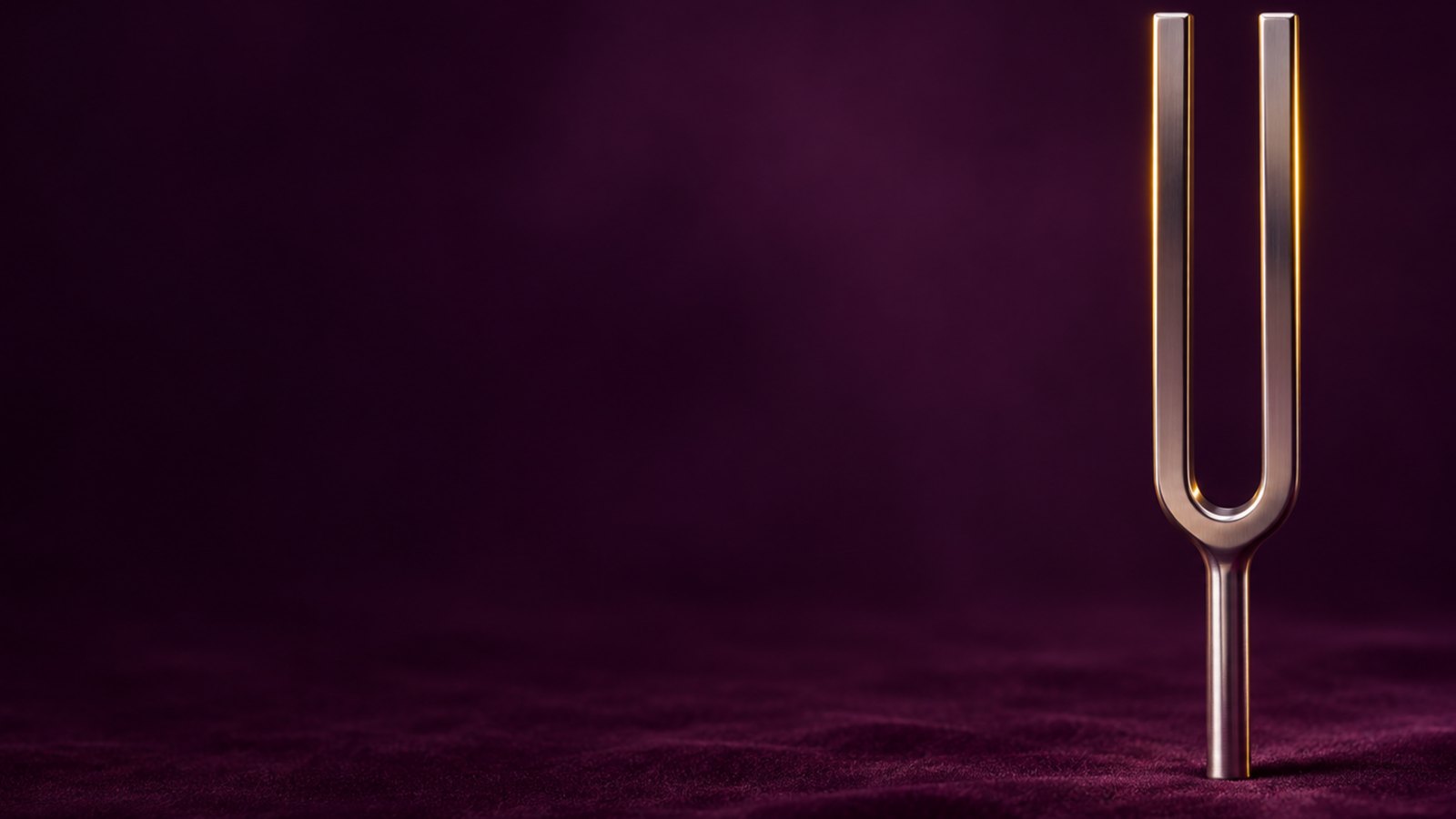
A tuning fork is a U-shaped bar of springy metal, usually steel or aluminum, with a short stem at the bottom. According to Wikipedia's tuning fork entry, its pitch depends on the length and mass of the two prongs, which are also called tines. Longer, heavier tines vibrate more slowly and give a lower note. Shorter, lighter tines vibrate faster and give a higher one.
When you strike a tine, both prongs start swinging in and out together. Acoustics professor Daniel Russell of Penn State describes this main motion, called the fundamental mode, as the two tines alternately moving toward and away from each other, each bending like a diving board fixed at the stem. This is the frequency printed on the fork. A fork marked 256 Hz, for example, swings back and forth 256 times every second.
Why the tone sounds so pure
Most instruments produce a rich blend of tones at once. A fork produces a few extra tones too, especially right after it is struck, which you hear as a bright, metallic "clang." According to Wikipedia, those higher overtones die out much faster than the main note, leaving a nearly pure sine wave at the fundamental frequency. That clean, single-pitched hum is what made forks so useful to musicians, and it is the quality people still enjoy today.
You may also notice that a fork held in the air sounds quiet. Wikipedia explains that the sound waves coming off each prong are out of step with each other, so they partly cancel out. Touch the stem to a wooden table or a hollow box and the note suddenly gets louder, because the larger surface helps carry the vibration into the air.
A short history: John Shore, 1711
The tuning fork was invented in 1711 by John Shore, an English trumpeter and lutenist who served as Sergeant Trumpeter to the royal court, according to Wikipedia's biography of him. Shore was a working musician. Composers including George Frideric Handel and Henry Purcell wrote trumpet parts specifically for him.
Wikipedia's tuning fork entry adds a lovely detail: the fork Shore gave to Handel produces a C at 512 Hz. For roughly three centuries afterward, forks were simply the standard way to give an orchestra, a choir or a piano tuner a reliable reference note. Their use as meditation and sound-bath instruments came much later.
Weighted vs unweighted tuning forks
This is the first real choice you will face when shopping, and it shapes how you will use the fork.
Weighted forks
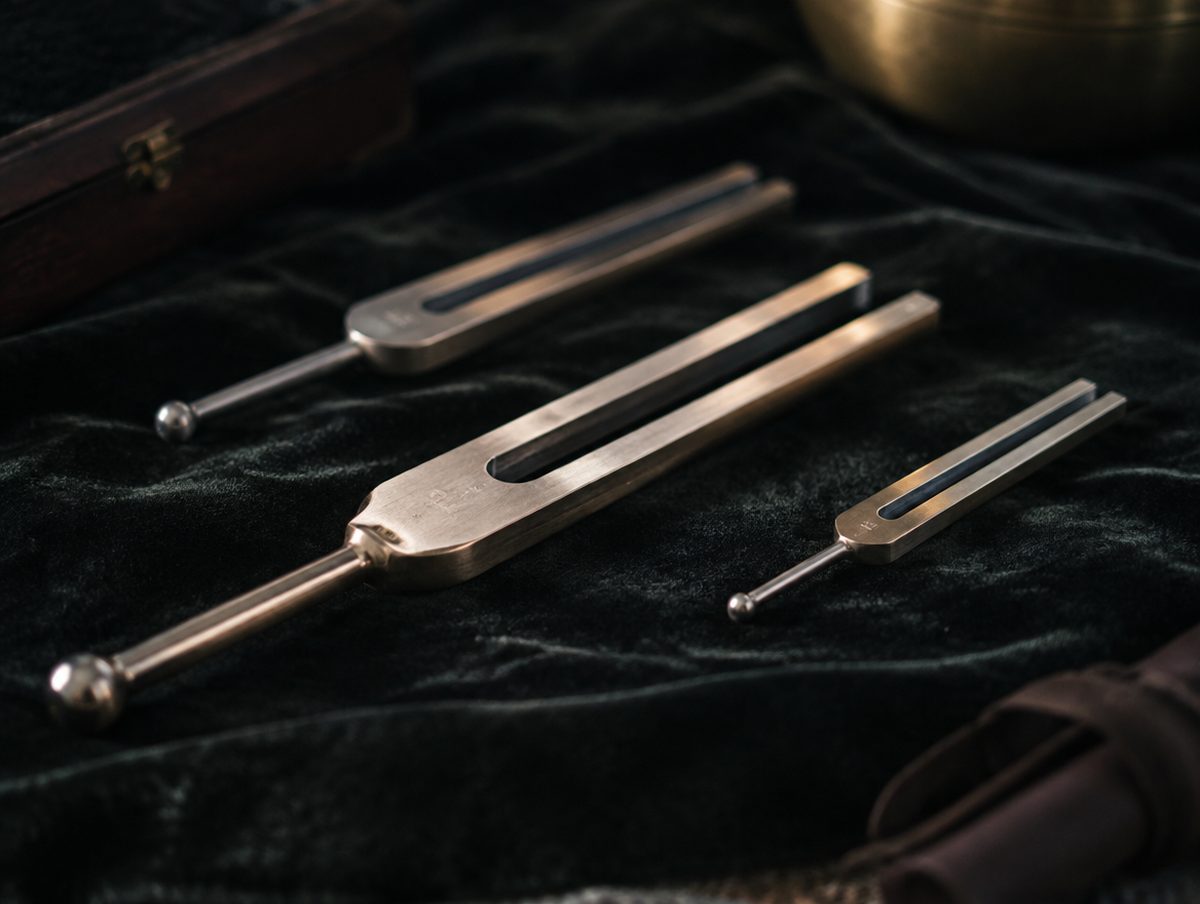
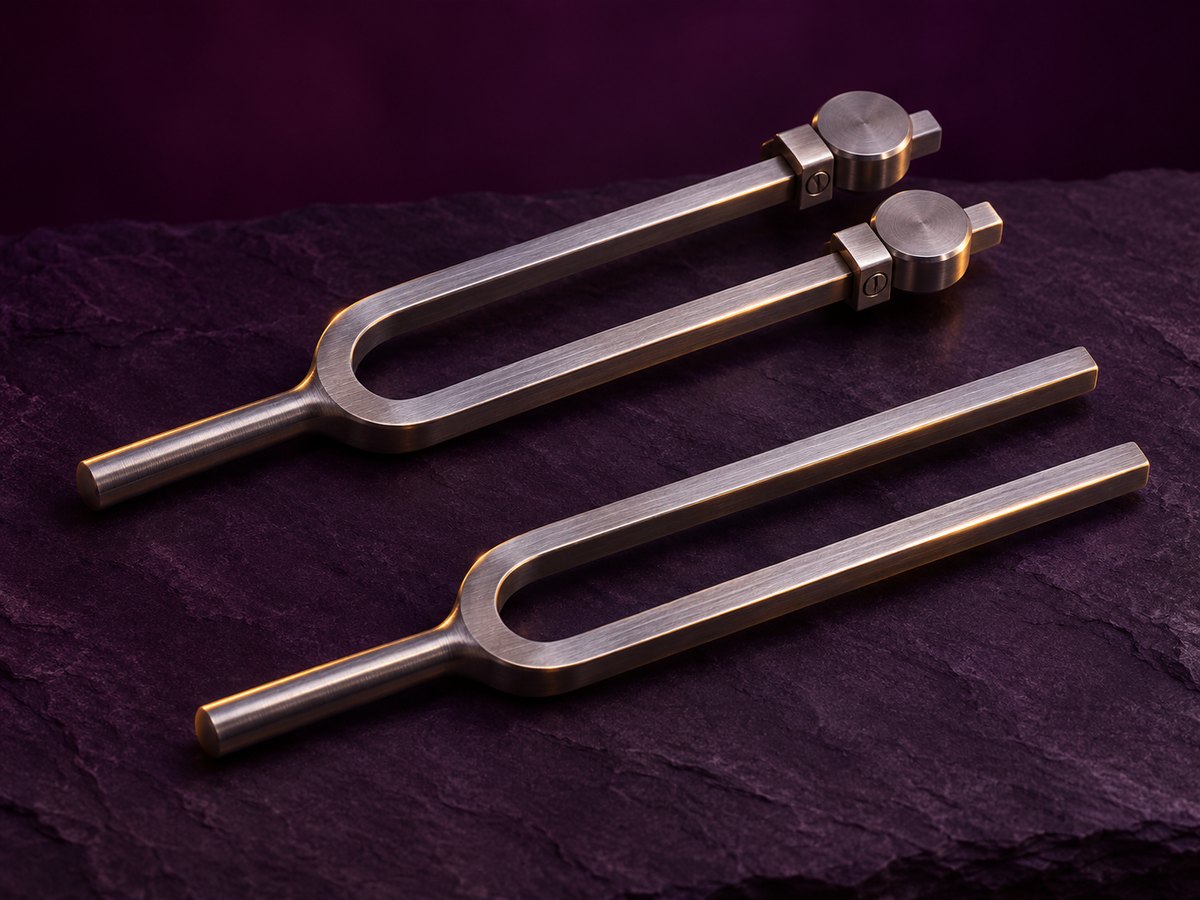
Weighted forks have small round weights fixed near the ends of each tine. According to Gongs Unlimited, those weights make the fork heavier and give a deeper tone with more power behind it, but they are actually harder to hear than unweighted forks. Their strength is what you feel. Sunreed's buying guide puts it simply: weighted forks can be heard, but their primary effect is felt. Practitioners usually strike one and rest the end of the stem lightly on the body, where many people describe a gentle, buzzing vibration.
Unweighted forks
Unweighted forks have plain tines. Gongs Unlimited notes that they are lighter, higher in pitch and easier to hear, but harder to feel physically. Sunreed adds that their sound carries more clearly through the air, often with a clear main tone plus a faint higher overtone. These are the forks people hold near the ears, move around the body without touching it, or ring during meditation.
Which should a beginner choose?
- If you want to listen, start with unweighted forks. They are the sound most people picture.
- If you want something to rest on the body, a single weighted fork is a gentle place to begin.
- If you can't decide, know that, as Gongs Unlimited points out, many practitioners keep some of each.
The common tuning fork sets
Forks are often sold in sets built around a theme. Here are the three you will see most.
Chakra tuning forks starting at C 256 Hz
The most traditional chakra set is a full musical octave of eight forks. According to SWB 256, a tuning-fork maker, this scale (also called the Harmonic Spectrum or Pythagorean scale) is based on C 256 Hz and its octave C 512 Hz, with the notes C 256, D 288, E 320, F 341.3, G 384, A 426.7, B 480 and C 512 Hz. In the chakra tradition, each note is paired with one of the seven energy centers, from root at the low C up to crown, with the top C completing the octave. Because every interval is a simple ratio, the forks also sound pleasant when played together in pairs.
Solfeggio forks
Solfeggio sets usually hold six or nine forks. According to HowStuffWorks, the core set is 396, 417, 528, 639, 741 and 852 Hz, and expanded lists add 174, 285 and 963 Hz. HowStuffWorks also explains that the medieval solfege syllables (ut, re, mi, fa, sol, la) never had fixed frequencies in hertz, and that this numbered system is a modern one popularized by Joseph Puleo and Leonard Horowitz. Many people enjoy these forks for meditation and intention-setting. It helps to see the meanings attached to each number as tradition and belief, not proven effects.
Planetary and Ohm 136.1 Hz forks
Planetary forks come from the work of Swiss mathematician and musicologist Hans Cousto, who published The Cosmic Octave in 1978, according to Gongs Unlimited. Cousto took the cycles of the planets, such as the length of a day or a year, and doubled them again and again until they fell into a range our ears can hear. In Cousto's own tuning fork notes, the frequency of the Earth year works out to 136.10 Hz, a C sharp he links to the sound "OM." This is the popular Ohm fork, often sold weighted for resting on the body and unweighted for listening. His sets also include the Sun, Moon and planets.
432 Hz vs 440 Hz: the story behind the debate
If you search for a 432 Hz tuning fork, you will quickly run into strong opinions. Here is the plain history.
Orchestras did not always agree on pitch. According to Wikipedia's concert pitch entry, France passed a law in 1859 setting the A above middle C at 435 Hz. Then, in 1939, an international conference recommended 440 Hz for that A. The International Organization for Standardization adopted it in 1955 and reaffirmed it in 1975 as ISO 16. That is why almost all modern music is tuned to A440.
A432 has its own history. Wikipedia's scientific pitch entry notes that the composer Giuseppe Verdi argued against rising orchestra pitch, insisted on the French 435 Hz standard for his Requiem in 1874, and later said 432 Hz would be slightly better. That is why 432 tuning is sometimes called "Verdi tuning." It sits close to the older "scientific pitch," which sets middle C at 256 Hz, the same C that starts the chakra set above.
Today, many musicians and sound practitioners prefer 432 Hz. They describe it as warmer, softer or more natural, and some believe it is more in tune with nature. Those are beliefs and listening preferences. Wikipedia notes that some online claims about 432 Hz are controversial, and HowStuffWorks makes a useful practical point: tuning to 432 changes only the reference A, not every note. If you love how it sounds, that is reason enough to own one.
How to strike a tuning fork
How you strike a fork changes how it sounds, and how long it lasts.
- Hold it by the stem. Touching the tines stops the vibration, as Sarveda's guide explains.
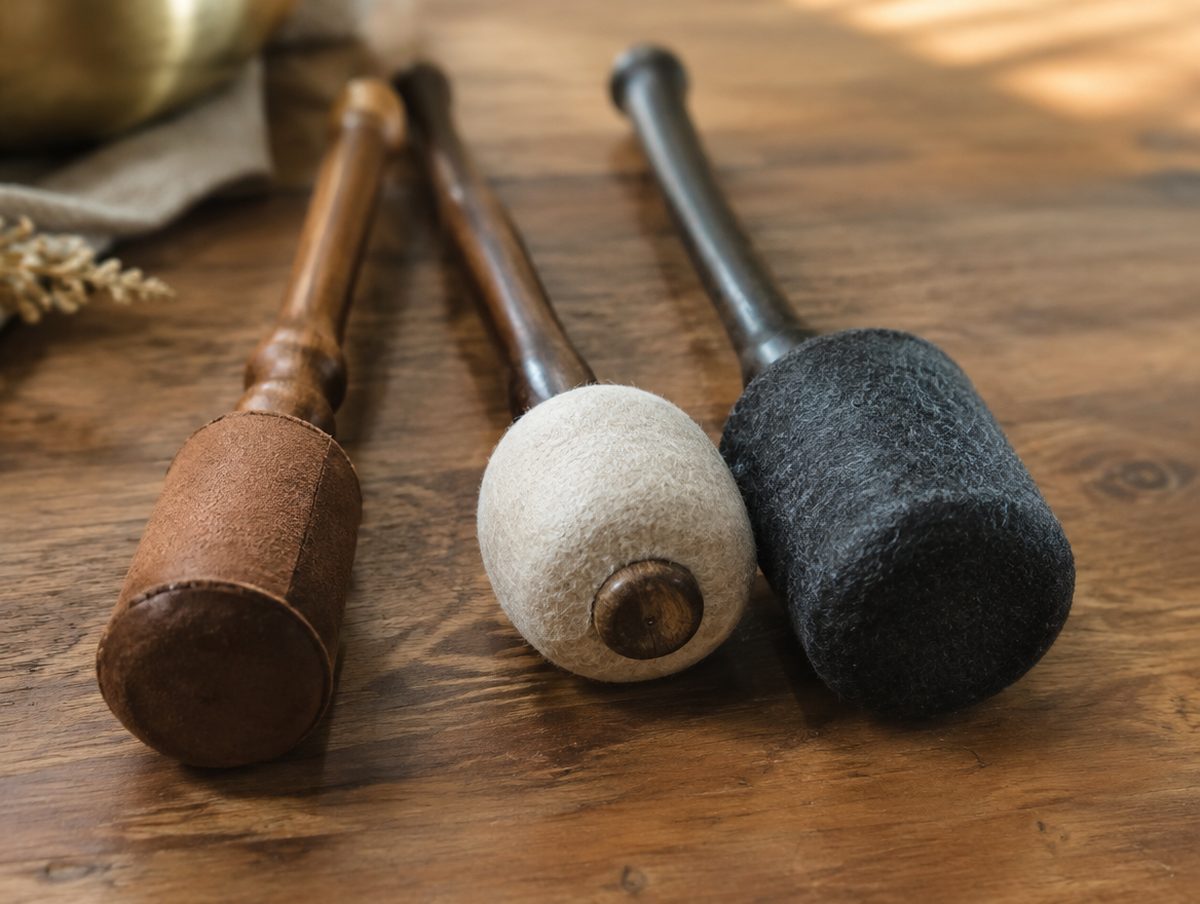
- Tap one tine on something soft. A rubber activator puck, a rubber mallet or your knee all work. Gongs Unlimited suggests tapping just hard enough to start the vibration, but not so hard that it makes a harsh clang.
- Never strike a hard surface. Sarveda warns that hitting a table, counter or another metal object can damage the fork and throw off its frequency.
- Aim below the tip. Vernier, a science-education company, suggests striking about two-thirds of the way down the tine toward the base. They note that a sharp, bright-sounding strike means extra unwanted overtones.
Once it is ringing, hold an unweighted fork a few inches from each ear in turn, or rest the stem of a weighted fork gently where it feels pleasant. Let it ring out, then strike again.
A few safety notes
- Keep a ringing fork a little away from your ear rather than touching it, and keep the volume comfortable.
- Soundtopia recommends a light tap, no forcing the stem onto the body, and stopping if you feel discomfort or dizziness.
- If you are pregnant, have an implanted electronic device, or are under a doctor's care, ask your doctor before resting a vibrating instrument on your body.
- Forks are small, pointed metal objects. Store them away from young children and pets.
Care and storage
A good fork can easily outlive its owner if you look after it.
- Wipe it after use. Soundtopia suggests a soft cloth after each session. This removes skin oils and moisture.
- Store it in a case or pouch. Most sets come in a fitted box. Keep forks from knocking together, since a dent or nick on a tine can change the pitch.
- Keep it dry. Many forks are nickel-plated steel, a finish that Meinl Sonic Energy says protects the surface against corrosion and abrasion. Aluminum forks are lighter and do not rust, but they scratch more easily.
- Don't file or grind it. According to Wikipedia, forks can be retuned by filing metal off the prongs, which is exactly why you should never sand or grind one yourself.
- Expect tiny shifts with temperature. Wikipedia notes that a steel fork drops very slightly in pitch as it warms. The change is too small to hear in normal use.
Tuning forks alongside singing bowls
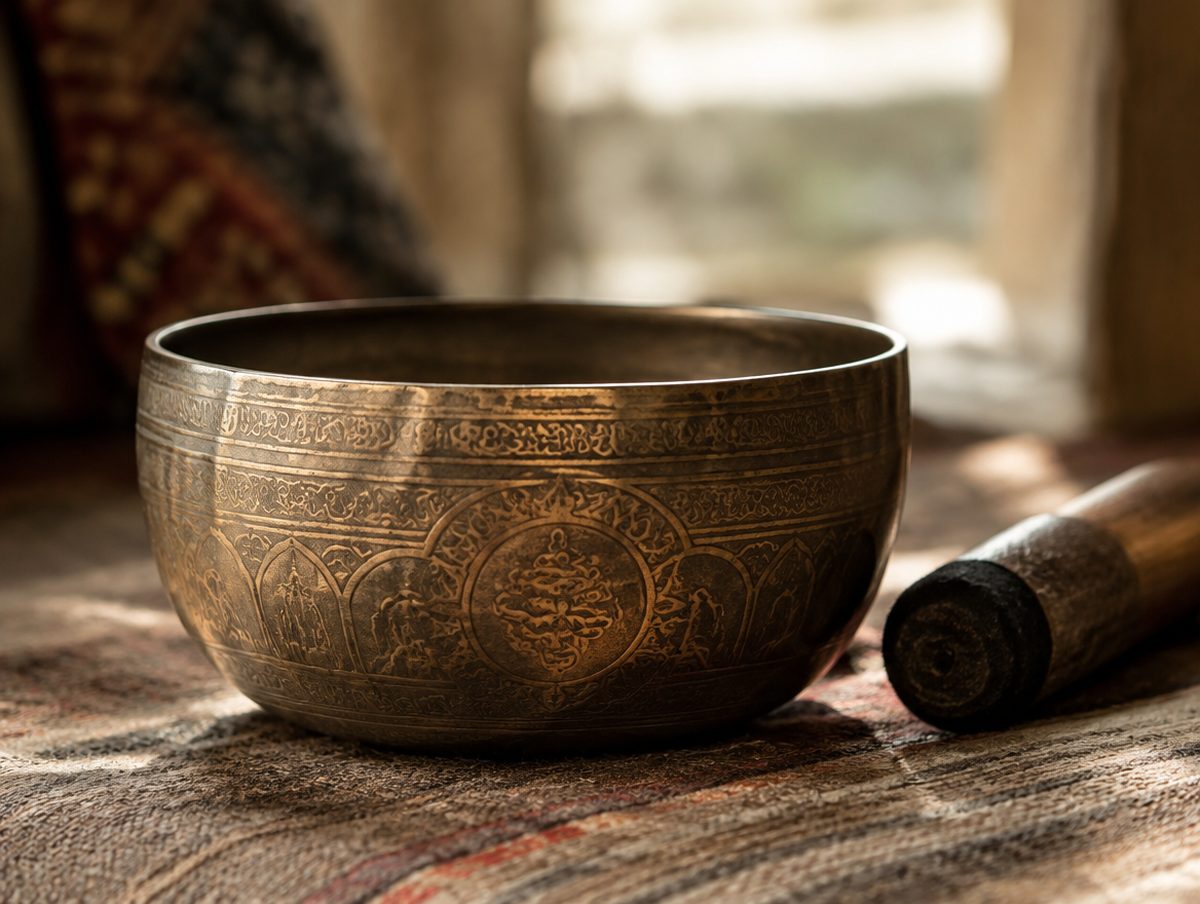
A singing bowl gives a broad, layered, room-filling sound. A fork gives a single clear note you can bring close and move around. Many people open a session with a bowl, then use a fork for quieter, closer moments, or ring a fork whose note matches the bowl. If you are new to bowls, start with our guide to singing bowls for beginners, and browse forks, bowls and mallets in our shop.
For those who want a heirloom-level instrument, iPyramids makes three pieces worth knowing about. Their Sound Swords are a chakra tuning-fork set starting at C 256 Hz, the same traditional scale described above. Their DNA Keys are a pair of double-ended forks tuned to D 288 Hz and A 432 Hz. And their Solar Bell is a bell tuned to A 432 Hz, a lovely bridge between the fork and bowl worlds. You can see all three in the sound collection.
Whatever you choose, start with one or two forks, learn to strike them gently, and spend time simply listening. The pure, steady hum of a well-made fork is a small, quiet pleasure, and it never gets old.
Quick answers
What is the difference between weighted and unweighted tuning forks?
Weighted forks have small weights near the tips of the tines. They give a deeper, quieter tone that you mostly feel when the stem rests lightly on the body. Unweighted forks have plain tines, a higher pitch and a clearer sound that carries through the air, so they are mainly for listening.
Is a 432 Hz tuning fork better than 440 Hz?
Neither is better in any proven way. A440 has been the international standard since the 1939 conference and ISO 16. Many people prefer the sound of 432 Hz and describe it as warmer or more natural. That is a matter of taste and belief, so choose the one you enjoy hearing.
What do I strike a tuning fork with?
Use something soft, such as a rubber activator puck, a rubber mallet or your knee. Hold the fork by the stem and tap one tine gently. Never strike it on a table, counter or other metal, which can damage the fork and change its pitch.
What frequencies are in a chakra tuning fork set?
The traditional chakra set is an octave based on C 256 Hz: C 256, D 288, E 320, F 341.3, G 384, A 426.7, B 480 and C 512 Hz. Each note is paired with one of the seven chakras in that tradition, and the top C completes the octave.